
 AU
AU

Most delivery software was built for parcels. A label, an address, a signature. That works fine when the product fits in a box. It does not work when you are moving mattresses, washing machines, or a three-seater sofa up a flight of stairs.
Furniture retailers and delivery teams in Australia are finding this out the hard way. Read on to learn more and discover the best solutions for shipping bulky goods.
What Appliance Furniture Delivery Actually Involves
Delivery logistics for furniture and other big and bulky items must include precise planning and coordination to ensure timely delivery, which may involve strategic choices regarding transport modes and routes.
Before a single item leaves the warehouse, the delivery team needs to know the dimensions, the weight, the access conditions at the delivery address, and whether the customer (and their location by extent) is available and ready to receive the order.
Three Service Tiers Retailers Need to Manage
Furniture delivery services operate via three main tiers: standard curbside drop-off, threshold delivery, and full-service white-glove delivery.
Curbside delivery is the most affordable option where the carrier drops items at the curb. It works for lighter items but creates problems for bulky goods that customers cannot move on their own.
Threshold delivery involves bringing boxes inside the home and placing them just past the front door. It reduces the burden on customers but leaves assembly and positioning to them.
White-glove goes further. Delivering bulky items typically involves various supplementary services including delivery to specific rooms, unpacking, installation, and even assembly, which can enhance customer satisfaction. For high-value furniture and appliances, this level of service is becoming the standard expectation, not a premium option.
The logistics of delivering bulky items requires careful planning and coordination, including managing delivery appointments, customer information, and additional services to ensure a smooth delivery experience.
What Regular Delivery Software Misses
Most delivery platforms were designed around parcels. Small, uniform boxes that fit in a van, scanned at the door, done. That works for a t-shirt or a phone case. It does not work for a washing machine, a sectional sofa, or a set of mattresses being moved to a regional address three hours from the nearest city.
It Wasn't Built for Bulky Freight
The limitations become obvious when retailers try to use standard delivery software for furniture delivery.
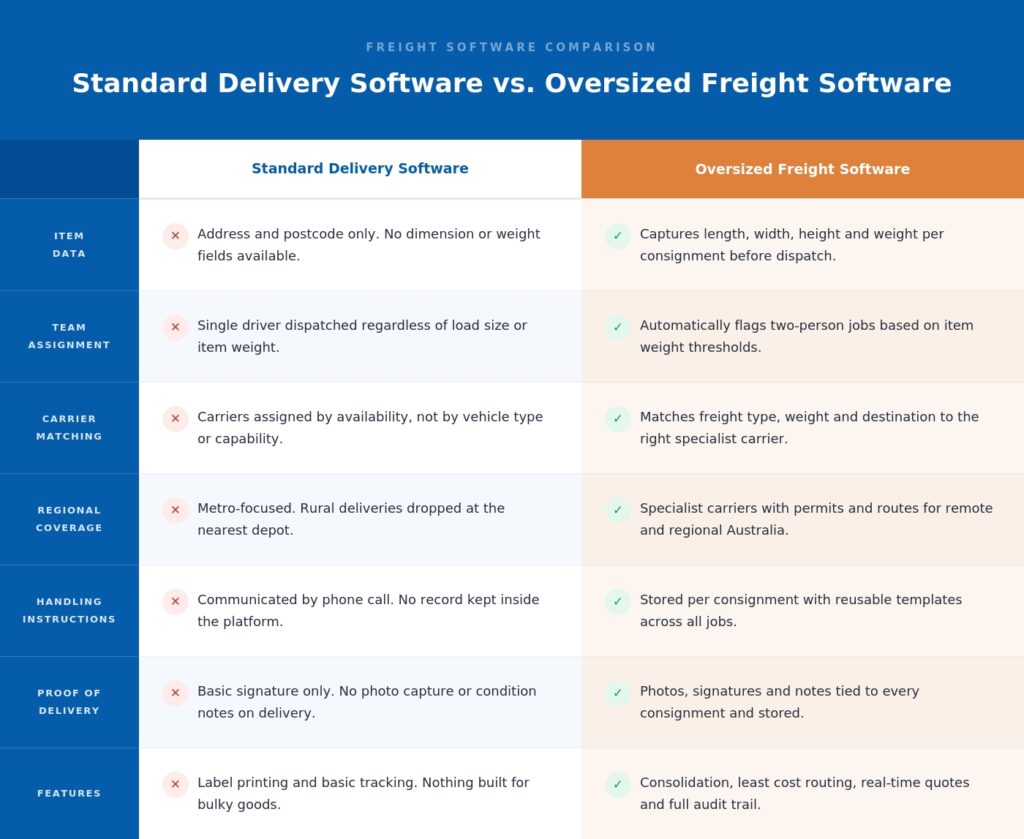
Most platforms cannot properly record dimensional data, match loads to suitable trucks, or flag jobs that require a ute, flatbed, tail lift, or specialised handling equipment. Delivery teams often rely on phone calls, spreadsheets, or emails to communicate important information, creating gaps in visibility and control.
Special handling instructions may never be recorded against the job. If an item is damaged, moved incorrectly, or delivered to the wrong location, there is often no audit trail showing what happened during the journey.
For businesses handling high volumes of furniture and appliances, that creates unnecessary risk and makes the process harder to manage.
Carrier Selection Becomes a Workaround
Carrier access is another area where standard platforms fall short.
Most parcel networks focus on metro delivery services and offer limited options outside major population centres. Yet furniture retailers regularly need access to specialist carriers capable of handling bulky goods in regional and remote areas.
Purpose-built furniture delivery software connects retailers with carriers that have the right vehicles, drivers, routes, and equipment for oversized freight. This helps ensure customers receive the same level of service whether they live in a capital city or a rural community.
Instead of relying on manual workarounds, retailers can book freight, track shipments, and manage carrier relationships through a single platform.
The Feature Gap Is Significant for Delivery Teams
The difference goes well beyond basic tracking.
Standard delivery platforms typically focus on label printing and parcel tracking. Furniture delivery software is built to support the operational realities of the furniture industry, including:
Freight consolidation
Rule-based carrier selection
Inventory management integration
Proof of delivery with photos and signatures
Delivery team coordination
API connectivity with existing business systems
Complete audit trails
For retailers managing furniture, appliances, mattresses, and other bulky goods across multiple warehouses and carriers, these features are not optional extras.
They are what make efficient delivery possible.
Software that Handles the Complex Operations
Software designed specifically for furniture delivery represents a different approach.
Rather than treating every shipment as a parcel, it captures detailed freight data at the consignment level, including dimensions, weight, packaging requirements, installation needs, and handling instructions. Loads are automatically matched to carriers that can safely transport the items being delivered.
This gives retailers greater control over the entire process while making life easier for warehouse teams, drivers, and customer service staff.
It also improves the customer experience by reducing delays, increasing visibility, and helping ensure products arrive safely at the end of the journey.
The Right Software Makes the Difference for Your Store
Furniture delivery is not a parcel problem, and treating it like one costs retailers time, money, and customers.
Consumers buying furniture online expect more than basic delivery. They expect reliable scheduling, live tracking, specialised handling, and a smooth experience from checkout to installation.
Retailers that can provide those services through the right carrier network and purpose-built software will continue to outperform those relying on platforms designed for parcels. For furniture and appliance retailers in Australia, oversized freight software is the practical way to deliver that experience at scale.

 Visit our US site