
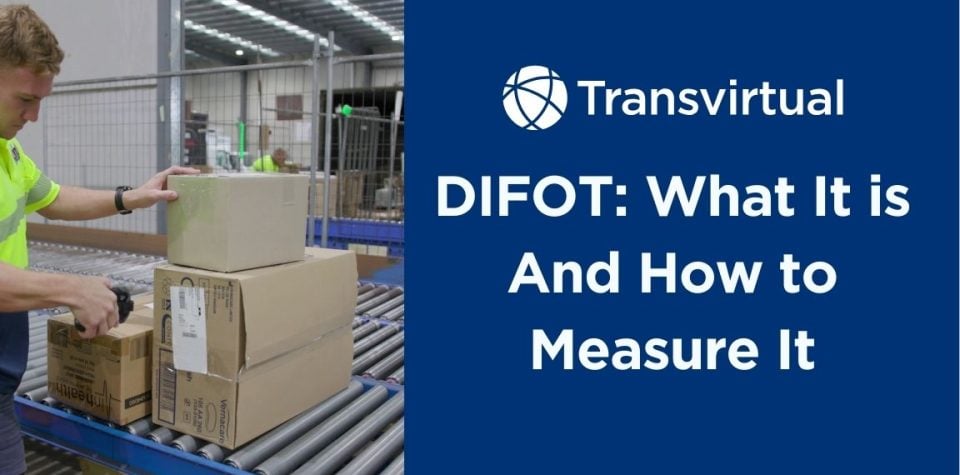
What Does DIFOT Mean?
DIFOT stands for Delivery In Full On Time. It’s a key logistics performance metric that measures how reliably and accurately orders are delivered to customers.
-
Delivery in Full means the customer receives the exact items and quantities they ordered—no missing products.
-
On Time means the delivery arrives within the scheduled time frame or ETA.
Tracking DIFOT helps businesses measure efficiency, improve order fulfillment, and ensure customer satisfaction. Some companies also use OTIF (On Time In Full), which is largely interchangeable with DIFOT, though DIFOT often focuses more on internal delivery standards.

How is DIFOT Calculated?
Calculating DIFOT is straightforward:
-
Check order completion – Determine whether items are Delivered, Not Delivered, or Partially Delivered.
-
Check on-time delivery – Confirm whether the delivery arrived within the ETA window.
-
Calculate the percentage – Use this formula:
DIFOT % = (Orders delivered in full and on time ÷ Total orders) × 100

Why is DIFOT Important?
DIFOT is a critical KPI for logistics companies because it measures:
-
Delivery accuracy – Ensuring customers get the correct items.
-
Timeliness – Arriving when expected.
-
Operational efficiency – Identifying bottlenecks and improving processes.
-
Customer satisfaction – Happy customers are more likely to return.
A high DIFOT score indicates your supply chain is performing well, while a low score signals areas that need improvement. Leading companies like Australia Post track DIFOT to optimize routes, monitor suppliers, and improve service.
Who uses DIFOT?
DIFOT is commonly used by businesses, carriers, and logistics teams to measure delivery performance. It is especially valuable for companies managing high shipment volumes, multiple delivery partners, or complex supply chains where meeting customer expectations depends on consistent, reliable deliveries.
While not every business tracks DIFOT formally, it provides a useful benchmark for understanding how often orders arrive complete and on time.
How is DIFOT used as a metric or KPI?
DIFOT is measured as a percentage, showing the proportion of deliveries that arrive in full and on time. A higher DIFOT score indicates stronger delivery performance and better supply chain reliability.
By monitoring DIFOT regularly, businesses can identify delivery issues, improve processes, and work with their logistics partners to maintain consistent service levels.
How to Improve DIFOT Performance
Improving your DIFOT is about understanding what affects it:
-
Inventory management – Make sure the right stock is available.
-
Route optimization – Plan efficient delivery routes.
-
Reliable suppliers – Reduce delays and errors.
-
Accurate demand forecasting – Avoid stockouts or overstocking.
-
Real-time monitoring tools – Quickly spot and fix delivery issues.
Using a TMS like TransVirtual helps automate DIFOT monitoring, track deliveries in real time, and improve overall performance.
DIFOT vs. OTIF
DIFOT and OTIF are similar, interchangeable terms. Both measure on-time, in-full delivery, and either can be used depending on what makes sense for your team.
Key Takeaways
-
DIFOT = Delivery In Full On Time.
-
It measures order accuracy, timeliness, and customer satisfaction.
-
A high DIFOT score builds trust, improves loyalty, and reduces costs.
-
Monitoring DIFOT with digital tools like Transvirtual makes tracking easier and more accurate.
Want to improve your DIFOT? Book a free demo with the Transvirtual team today and see how real-time reporting can help your logistics business deliver better, faster, and smarter.
FAQs About DIFOT
DIFOT stands for Delivery In Full On Time, a key logistics KPI that measures how accurately and punctually orders are delivered to customers.
A low DIFOT score is usually caused by a combination of inventory shortages, poor route planning, unreliable suppliers, and inaccurate demand forecasting.
Any one of these can lead to late arrivals or incomplete orders, and in most cases it's a mix of factors rather than a single cause, which is why real-time monitoring is so useful for isolating exactly where the breakdown is happening.
DIFOT should be measured continuously and reviewed on a regular cadence, typically weekly or monthly, depending on order volume.
Continuous tracking lets teams catch and correct problems quickly, while regular reviews help identify longer-term trends across suppliers, routes, or delivery partners.
Software alone won't fully fix a low DIFOT score, but it makes the biggest difference when paired with good operational practices.
A TMS can automate tracking, flag issues in real time, and surface patterns across routes and suppliers, but inventory accuracy, forecasting, and supplier reliability still need to be managed on the operations side for DIFOT to improve sustainably.