
 AU
AU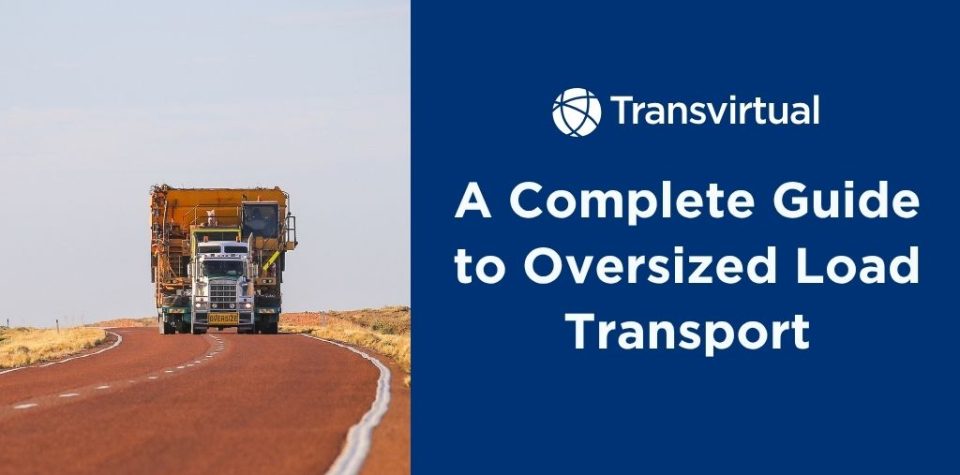
Table of Contents
Moving a large piece of machinery, medical equipment, or an indivisible industrial structure from A to B is not like moving a standard pallet. The moment a load exceeds legal road dimensions, you aren't just arranging freight — you need to manage a web of permits, route approvals, escort requirements, and compliance obligations that vary depending on where you are in Australia and what you are carrying.
This guide is written for shippers who need to understand what is involved before committing to a move. Getting this right from the start saves time, avoids costly delays, and keeps your cargo — and everyone on the road — safe.
What Counts as an Oversized Load?
An oversized load (or oversized cargo) is any load that exceeds the standard legal dimension limits set by road transport authorities. In Australia, a load is generally classified as oversized if it is wider than 2.5 metres, taller than 4.3 metres, or longer than 19 metres. Loads exceeding standard weight limits are classified as overmass and carry their own additional requirements.
The item being transported must generally be indivisible to qualify as an oversized load — meaning it cannot practically be reduced in size for transport. Common examples include large construction equipment, mining machinery, pressure vessels, crane components, and wind turbine parts.
Shippers, transport operators, and road authorities are the primary stakeholders. Involving all three early in the planning process is the single most effective way to avoid costly surprises.
Oversized Load Transport Regulations
Oversized load transport in Australia operates under the Heavy Vehicle National Law (HVNL), administered by the National Heavy Vehicle Regulator (NHVR). The HVNL applies across Queensland, New South Wales, Victoria, South Australia, Tasmania, and the ACT. Western Australia and the Northern Territory operate under their own separate legislation and permit systems.
Under the HVNL framework, loads that exceed standard access conditions are classified as Restricted Access Vehicles (RAVs). A permit is required for any RAV operating on public roads. There is no grey area here: if your load exceeds legal dimensions or mass limits, you need a permit before wheels turn.
Required Permits for Oversized Load Transport
Class 1 Permits
Class 1 permits are for indivisible loads that cannot be split for transport, such as large machinery, cranes, and oversized structural components. Current exemptions allow vehicles up to 5.5 metres wide, 5 metres high, and 35 metres long.
Class 2 Permits
Class 2 permits cover approved vehicle combinations such as B-doubles and road trains operating under standard access conditions. If the vehicle configuration fits a recognised Class 2 category, this is the required permit.
OSOM Permits
OSOM (Oversize Overmass) permits are required when a load exceeds both size and weight limits. These applications often require additional documentation, engineering certification, and route approval, resulting in longer processing times.
Temporary vs. Ongoing Permits
Temporary permits are intended for one-off journeys or short-term transport. Operators moving similar oversized loads on a regular basis can apply for ongoing or term permits, reducing repeat applications and simplifying ongoing operations.
Escort Vehicles and Permit Conditions
Some oversize loads require one or more escort vehicles (and even a traffic escort warden), depending on their dimensions, route, and road conditions. Permits may also include conditions such as approved travel times, warning signage, lighting requirements, or route restrictions to help maintain road safety and minimise traffic disruption.
Simple permit applications may be processed within a few days, while complex OSOM applications can take significantly longer. Allow enough time before the planned move to avoid delays.
If You Are Outsourcing the Move
Most shippers do not run their own heavy vehicle fleet. If you are engaging a third-party transport operator or freight broker to move an oversized load, the regulatory responsibility does not disappear — it shifts and in some cases is shared.
Under the Heavy Vehicle National Law (HVNL), the Chain of Responsibility (CoR) extends legal obligations beyond the driver and the transport company to every party whose decisions affect heavy vehicle safety. As a shipper, that includes you. If you provide incorrect load dimensions, set unrealistic timelines that pressure a driver to move without a permit, or instruct a carrier to take a route that has not been assessed, you can be held liable under the HVNL — even if you never touch the vehicle.
What this means in practice:
Provide accurate, verified load dimensions and weight to your transport operator before the job is booked. Do not estimate.
Do not set delivery deadlines that cannot be met under permit conditions. Permit processing takes time. Night travel curfews restrict operating windows. These are not negotiable.
Confirm in writing that your operator holds the correct permit for the movement before the load departs. Ask for the permit number.
If your operator sub-contracts the move, the same obligations apply down the chain. Know who is actually moving your freight.
If something goes wrong on a permitted oversized move — an unassessed bridge is damaged, a load shifts and causes an incident, a route condition is breached — enforcement authorities will look at everyone in the chain, not just the driver.
Transporting Oversized Loads: Get it Right
Oversized freight involves more variables than standard freight at every step — permit types, state-specific conditions, escort logistics, route approvals, axle configurations, and documentation requirements across multiple parties.
Shippers who move oversized freight regularly find that managing consignment detail, carrier matching, handling instructions, and delivery visibility across jobs quickly outgrows manual processes. Capturing accurate dimensional data, assigning specialist carriers, maintaining an audit trail on every job, and giving customers live visibility on complex deliveries are operational requirements that benefit from purpose-built tooling.
Transvirtual's oversized freight solution handles end-to-end consignment management for non-standard freight — including carrier matching for permit-required shipments, consolidation controls for multi-item loads, handling instruction templates, and live tracking even on complex oversized deliveries.
Frequently Asked Questions
An oversized load is any load that exceeds standard legal road dimensions — wider than 2.5 metres, taller than 4.3 metres, or longer than 19 metres. Loads that also exceed mass limits are classified as overmass and require an OSOM permit.
Yes. Under the Chain of Responsibility provisions of the HVNL, shippers are legally obligated to ensure their actions do not contribute to a breach of heavy vehicle laws. Providing inaccurate load data, setting timelines that force a departure without a permit, or directing an operator to use an unassessed route can all result in shipper liability.
A permit is required any time a load or vehicle configuration exceeds legal road access conditions (and yes, you need special purpose vehicles when transporting across main roads). This applies to all Restricted Access Vehicles on public roads, regardless of distance or trip frequency.
Standard freight policies often exclude permit-required or overheight movements. Obtain a policy that explicitly covers oversized load transport, or confirm in writing that your transport operator's coverage extends to the specific movement.

 Visit our US site