
 AU
AU
Freight companies are under constant pressure to move more freight with fewer errors and lower operational costs. Freight automation tools solve this by connecting data across the entire supply chain and turning repetitive tasks into automated workflows that support faster decisions and stronger customer satisfaction.
This guide breaks down what freight automation actually means and how to evaluate a freight management system for your operations.
What Is Freight Automation?
Freight automation uses software and robotic process automation (RPA) to replace manual logistics tasks.
Instead of re-entering data across systems, automated workflows pull information directly from carriers, customers, and existing platforms, reducing errors and manual work throughout the shipment lifecycle.
It can automate rate management, booking, tracking, reporting, quoting, document generation, and real-time shipment updates. By reducing repetitive tasks, businesses can manage higher shipment volumes without increasing headcount, making it easier to scale and enhance customer satisfaction.
Why Freight Companies Are Investing in Automation Tools
The logistics industry is investing in automation to achieve three key goals: reduce costs, improve efficiency, and deliver a better customer experience.
Automation takes over repetitive tasks like data entry, rate lookups, and document processing. This allows logistics teams to spend less time on administration and more time handling exceptions, solving problems, and supporting customers.
Modern freight management systems also streamline quoting, invoicing, booking, and reporting. By reducing manual work, companies can process more shipments with fewer administrative resources.
The business case for automation is backed by measurable results:
Robotic process automation (RPA) can eliminate up to 99% of routine administrative tasks in freight operations.
AI-powered route optimization can reduce fuel consumption by around 15%.
Predictive load planning can lower fuel costs by an additional 12%.
Automated quoting can increase win rates by 15–30%, with some platforms generating quotes in under 10 seconds.
Automation can reduce manual processing time by more than 70% across freight audit, booking, and reporting.
Automated workflows can achieve up to 99.9% data accuracy.
Route and load optimization can reduce empty trailer kilometres by nearly 18%, lowering both fuel and operating costs.
Together, these improvements help freight companies operate more efficiently, control costs, and scale without adding unnecessary administrative overhead.
Key Automation Features to Look for in a Freight Management System
The right features determine how much manual data entry a freight management system can eliminate. Here's what to prioritize:
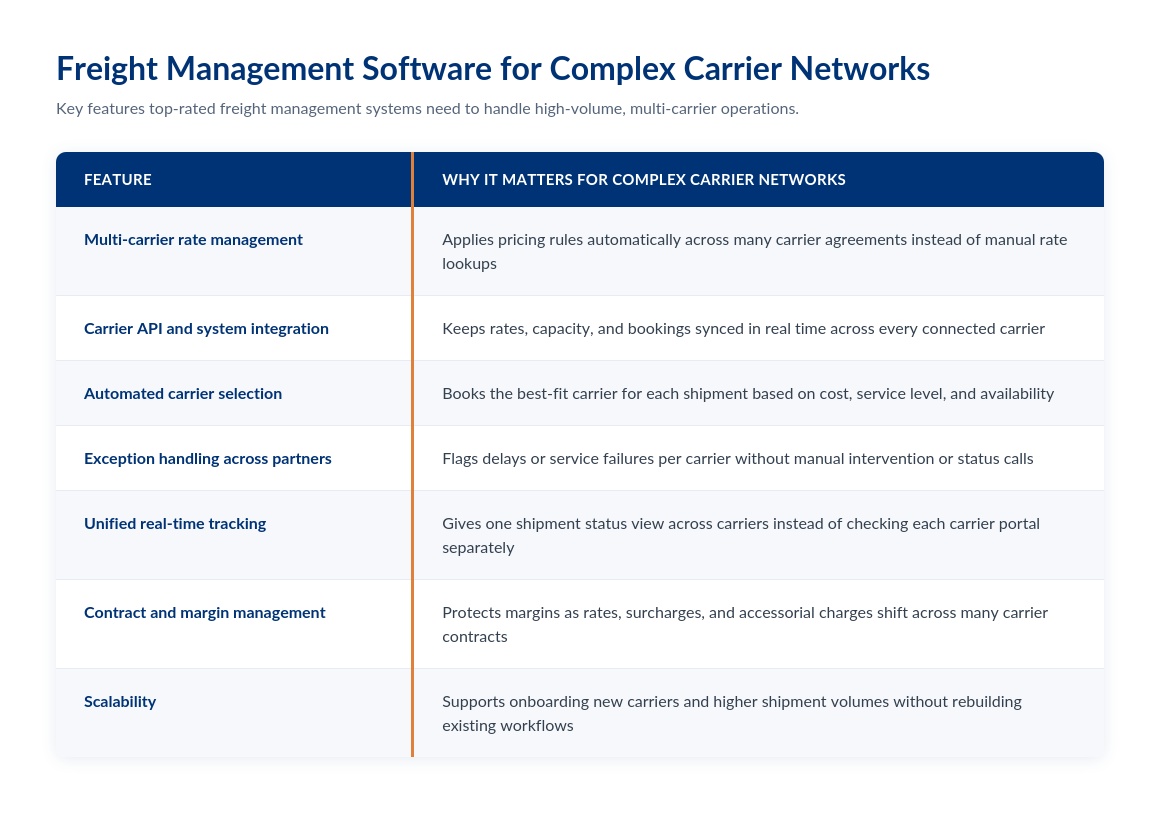
Comparing Freight Management Software for Complex Carrier Networks
Most freight automation features work for any operation, but managing multiple carrier relationships requires a few additional capabilities:
Automated carrier selection: Match shipments with the right carrier based on cost, availability, and service requirements.
Carrier-specific exception management: Track delays and service issues by carrier instead of managing everything through generic alerts.
Contract and margin management: Manage changing rates, surcharges, and accessorial fees to protect margins.
Faster carrier onboarding: Add new carriers and lanes without lengthy setup or custom development.
Without these capabilities, teams often end up relying on manual processes and separate carrier workflows.
Transvirtual helps freight companies manage domestic carrier networks in Australia through a single platform, reducing the need to switch between multiple carrier portals.
How to Evaluate a Freight Automation Platform
When comparing freight automation platforms, focus on the factors that will have the biggest impact on your operations:
Identify your biggest bottlenecks. Look for software that automates time-consuming tasks such as quoting, dispatch, invoicing, and manual data entry.
Choose end-to-end automation. Platforms that automate the entire shipment lifecycle provide more value than tools that only solve a single task.
Check integration capabilities. Make sure the platform connects with your ERP, accounting software, carrier networks, and other core systems to reduce duplicate data entry.
Plan for growth. Select a platform that can support higher shipment volumes and additional users as your business expands.
Evaluate return on investment. Compare the long-term savings from fewer errors, lower operating costs, and improved productivity, not just the monthly subscription price.
If you need help evaluating your options, we're happy to help! Transvirtual offers a free consultation with our experts. We'll assess your business and give you an honest evaluation if we're the right fit.

 Visit our US site