
 AU
AU
Freight invoices pile up fast when you're working with multiple carriers, and most operations teams don't have time to check every line item against a rate card.
A business processing five hundred consignments a month across six carriers can easily generate thousands of invoice line items in that same period. Overcharges, duplicate invoices, and small billing discrepancies hide easily in that volume, and left unchecked, they add up to real money leaving the business every billing cycle.
A freight audit process exists to catch exactly this. Done properly and on a regular basis, it isn't just a compliance exercise, it's one of the more reliable ways to recover cost, improve carrier accountability, and get full visibility into what you're actually paying for.
Overview of Freight Auditing
Before opening a single invoice, an audit needs boundaries. Without them, freight audits stall out somewhere between the spreadsheet and the inbox.
Define Audit Scope
Decide upfront which carriers, service types, and cost categories the audit will cover. A full audit checks every carrier invoice against contracted rates. A targeted audit might focus only on fuel surcharges, or only on the two carriers with the highest spend. Both are valid, but the scope needs to be written down before the process starts, not decided invoice by invoice.
Set Audit Timeframe
Freight audits work best on a regular basis rather than as a one-off event. Monthly audits catch billing errors before they compound across several invoice cycles, while quarterly audits are more realistic for smaller operations with lower transaction volume. Whichever cadence you choose, keep it consistent so trends in carrier performance and billing accuracy are actually comparable over time.
List Internal and Carrier Stakeholders
An audit checklist is only as good as the people executing it. Identify who owns the audit internally (usually finance or logistics operations), who signs off on credit requests, and which carrier contacts handle invoice disputes. Having this list ready before an issue arises shortens the time between finding a discrepancy and resolving it.
Pre-Audit Preparation: Collect Freight Invoices and Documents
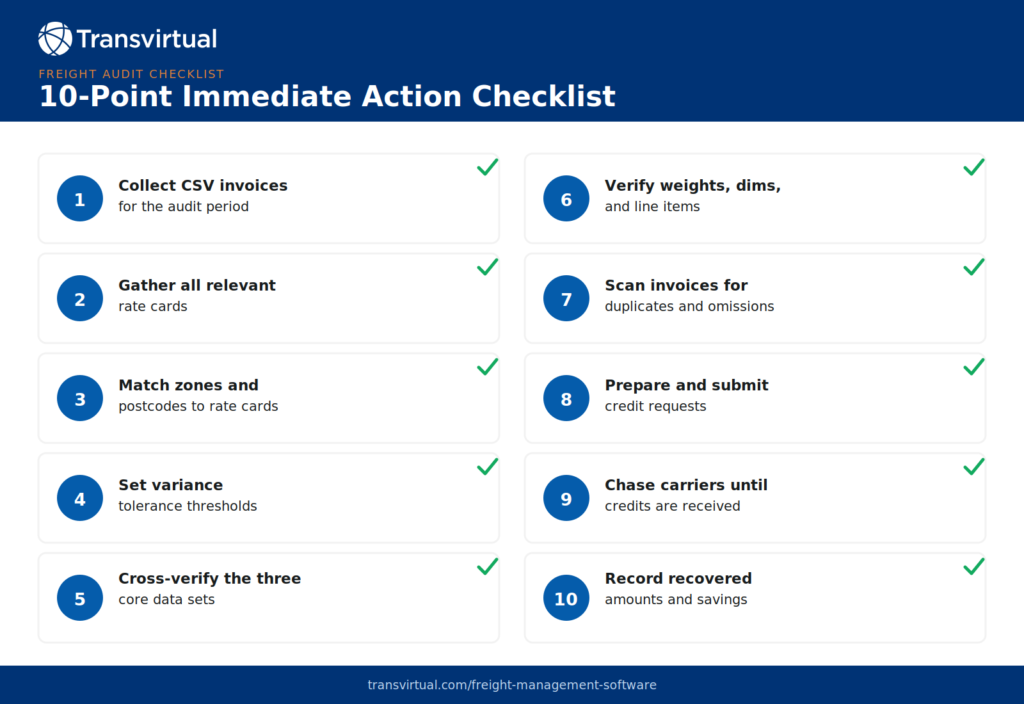
Every freight audit process runs on three core data sets: the invoice, the contract, and the shipment record. Missing any one of them turns verification into guesswork.
Collect All Freight Invoices in CSV Format
Pull carrier invoices for the audit period in CSV format wherever possible. A structured export makes it far easier to cross-verify line items programmatically or in a spreadsheet, rather than manually reading through PDF statements one by one.
Gather Rate Cards and Signed Carrier Contracts
Every carrier invoice should be checked against the rate card and contract terms that were actually agreed. This includes base rates by zone and postcode, accessorial charges, and any fuel surcharge formulas. Outdated rate cards are one of the most common causes of billing discrepancies that have nothing to do with carrier error.
Export Bills of Lading and Shipment Manifests
The bill of lading and shipment manifest confirm what was actually shipped, its weight and dimensions, and any special handling requirements. These documents are what you'll use to confirm that an invoice reflects actual services rendered rather than what was originally booked.
Audit Checklist: Line-Item Freight Invoice Verification
This is where the audit checklist earns its keep. Each line item on a carrier invoice gets checked against the data collected in the previous step.
Verify Contracted Rates for Each Line Item
Match the rate charged on each invoice line to the rate card for that carrier, zone, and service level. Even a small per-shipment variance becomes a significant cost recovery opportunity once it's multiplied across a full invoice cycle.
Confirm Weight and DIM Accuracy Per Shipment
Weight and dimensional (DIM) discrepancies are a frequent source of overcharges, particularly when a carrier reweighs or redimensions a shipment in transit. Cross-check the invoiced weight against your own shipment record, and flag any variance that falls outside a reasonable tolerance.
Check Accessorials Match Recorded Services
Accessorial charges (residential delivery, liftgate, redelivery, and similar) should only appear on an invoice if that service was actually requested and recorded against the shipment. This is one of the easier checks to automate, and one of the most commonly skipped in a manual audit.
Flag and Isolate Duplicate Charges
Duplicate invoices and duplicate charges within a single invoice are more common than most teams expect, especially where multiple carriers or freight forwarders are involved in the same shipment. Isolate anything that appears twice against the same consignment number before it gets paid twice.
Freight Auditing Tools, Automation, and Integration
Manual freight auditing doesn't scale much past a handful of carriers before it becomes genuinely time consuming. This is where auditing software and automation earn their place.
Evaluate Freight Audit Software Capabilities
Look for auditing software that can ingest invoices in bulk, apply rate cards automatically, and surface exceptions rather than requiring a person to review every line. The goal is to spend audit time on the discrepancies that need a decision, not on the majority of line items that are already correct.
Integrate Audit Tools With TMS/FMS and ERP
Freight audit tools that sit outside your transport/freight management system create double handling, since someone has to move invoice, rate, and shipment data between systems manually.
Automate Carrier Invoice Reconciliation Workflows
Automating the reconciliation workflow, matching invoices to rate cards, flagging variances outside tolerance, and routing exceptions to the right person, turns a process that used to take days into one that surfaces only what actually needs a human decision. This is one of the areas where a connected freight management platform makes the biggest practical difference, since invoice data, carrier records, and consignment history are already sitting in one place rather than scattered across spreadsheets and separate carrier portals.
Audit Team, Training, and Best Practice
Freight audits are only effective when the team understands how to interpret and act on the results.
Assign clear ownership: Define who manages the audit process, reviews discrepancies, and submits carrier credit requests to ensure issues are resolved promptly.
Train on contracts: Teach staff how to interpret carrier contracts and rate cards accurately to avoid audit errors and unnecessary disputes.
Document best practices: Standardize the audit process from data collection to credit recovery and share it across the team for consistent execution.
Simplify Freight Auditing with Automation
If you're looking to bring more structure and automation to how your team handles carrier invoices and freight audits, Transvirtual's Freight Management Software is worth a look.
You can try our free FMS demo, no sales call or commitment required. Explore the platform at your own pace and see how it can optimize your freight management operations.

 Visit our US site