
Table of Contents
We often talk about supply chain software and its role in improving logistics procedures. Two tools that take the spotlight within the broader supply chain management strategy are Freight Management Software (FMS) and Transport Management Systems (TMS).
While certain functions tend to overlap, they each have a distinct purpose and benefits. Understanding the distinctions between these supply chain software systems is crucial.
In this post, we’ll examine the key features of both FMS and TMS, equipping you with the insights needed to choose the right solution for your business.
Comparing Freight Management Systems vs. Transport Management Systems
Let’s start with what they both do: A Transportation Management System (TMS) plays a critical role in managing logistics operations effectively, while an FMS can improve transportation efficiency and profitability. When used together, they help businesses fulfill their transportation and logistics needs.
Freight Management Software
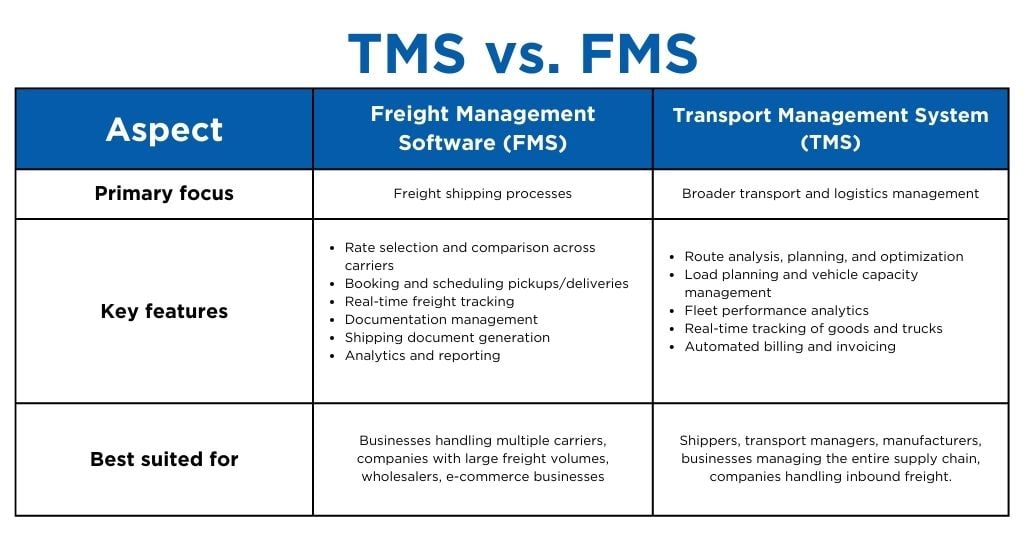
A freight management system (or software) is, as the name implies, focuses on the freight shipping process. It offers a centralised platform for carrier management along with invoicing and reporting features.
Key features of an FMS include:
-
Select and compare rates from multiple carriers, helping you choose the most cost-effective solutions
-
Book and schedule pickups or deliveries
-
Real-time freight tracking features
-
Documentation management; generate shipping documents such as invoices or bills of lading
-
Analytics and reporting to help you identify trends and make data-driven decisions
Who needs an FMS?
When handling multiple carriers or large freight volumes, an FMS—with its integration capabilities—can significantly streamline operations. Businesses that rely heavily on freight shipping to distribute products (wholesalers, ecommerce businesses) would benefit from an FMS as well.
Transportation Management Software
While an FMS focuses on freight shipping, a TMS covers transportation and logistics, helping to optimize transportation operations. Additionally, transportation planning within a TMS plays a crucial role in optimizing shipment routes and selecting carriers. This includes your drivers, fleet, and third-party carriers. Oftentimes, this is where an FMS and TMS overlaps as they both have documentation, carrier management, and route optimisation features.
Key features of a TMS include:
-
Route analysis, planning, and optimisation
-
Load planning, giving you the ability to assess goods distribution and vehicle capacity
-
Analytics capabilities, providing insights into fleet performance
-
Real time tracking of goods and trucks
-
Automated billing and invoicing
Who needs a TMS?
A TMS offers a comprehensive view of transportation, freight management, and analytics. Among the most common end users are shippers, transport managers, and manufacturers.
That said, a TMS is better suited for businesses that deal with the entire supply chain process. It’s also a must-have if you’re managing inbound freight.
A TMS is a broader system that covers transportation and logistics, including drivers, fleet, and third-party carriers. On the other hand, an FMS is a system that focuses specifically on freight shipping, including carrier management, invoicing, and reporting.
Similarities and Differences
While both Transportation Management Systems (TMS) and Freight Management Systems (FMS) are designed to improve logistics procedures, they have distinct differences in their functionality and scope. A TMS is a broader system that covers transportation and logistics, including drivers, fleet, and third-party carriers. On the other hand, an FMS is a system that focuses specifically on freight shipping, including carrier management, invoicing, and reporting.
Despite their differences, both TMS and FMS share some similarities. Both systems aim to streamline logistics and transportation processes, enhance visibility and control, and improve operational efficiency. They also offer real-time tracking capabilities, allowing businesses to monitor the status and location of shipments.

Choosing the Right System
Choosing the right system for your business depends on your specific needs and goals. If you are looking for a system that can handle the entire transportation and logistics process, a TMS may be the better choice. However, if you need a system that focuses specifically on freight shipping, an FMS may be the way to go.
Factors to Consider
When choosing between a TMS and an FMS, there are several factors to consider. These include:
-
The scope of your logistics operations: If you need to manage the entire transportation and logistics process, a TMS may be the better choice. However, if you only need to manage freight shipping, an FMS may be sufficient.
-
The complexity of your operations: If you have complex logistics operations, a TMS may be better equipped to handle your needs. However, if your operations are relatively simple, an FMS may be sufficient.
-
Your budget: TMS and FMS can vary significantly in terms of cost. If you have a limited budget, an FMS may be the more affordable option.
Impact on Business Operations and Efficiency
Implementing a TMS or FMS can have a significant impact on business operations and efficiency. Both systems can help streamline logistics and transportation processes, reduce costs, and improve customer satisfaction.
However, the impact of a TMS or FMS will depend on the specific needs and goals of your business. If you choose the right system for your business, you can expect to see improvements in operational efficiency, reduced costs, and improved customer satisfaction.
FMS or TMS: Why Not Both?
Integrating your FMS and TMS allows businesses to leverage the strengths of each system. Your FMS will excel in managing freight-related tasks, such as carrier management and tracking, while your TMS offers broader features such as load planning and route optimisation.
Larger enterprises with more complex transportation networks benefit greatly when these systems work in tandem.
TransVirtual can help you determine which logistics software has the capabilities to meet your needs. We offer a zero-commitment strategy session where we discuss your biggest logistics challenges and propose the best solutions for them.
Schedule a call at your convenient time today!
Frequently Asked Questions
- What is the main difference between a TMS and an FMS?
A TMS manages and optimises the overall transportation operations, including fleet, drivers, vehicles, or third-party carriers, route planning, load planning, and full delivery logistics.
An FMS focuses specifically on freight shipping: it helps you manage freight bookings, carrier relationships, documentation (invoices, bills of lading), and freight-level tracking and reporting.
- When would a business need an FMS instead of (or in addition to) a TMS?
FMS is ideal if your business handles multiple carriers or large freight volumes, such as wholesalers or e-commerce companies, that rely on external freight services to deliver goods.
If you manage your own vehicles, or handle inbound and outbound logistics including routing, delivery, and fleet operations, a TMS is more suitable.
- What are the key features of a TMS?
Here are the key features of a TMS:
-
Route analysis, planning, and optimisation for shipments.
-
Load planning to assess goods distribution and vehicle capacity.
-
Real-time tracking of goods and (if applicable) trucks or vehicles.
-
Automated billing and invoicing for transported goods.
-
Analytics to provide insights into fleet performance and overall logistics efficiency.
-
- What are the key features of an FMS?
Here are the key features to look for in an FMS platform:
-
Compare rates from multiple carriers to find the most cost-effective option.
-
Book and schedule pickups or deliveries with carriers.
-
Real-time freight tracking.
-
Documentation management — e.g. generating invoices or bills of lading.
-
Analytics and reporting to monitor freight operations and make data-driven decisions
-