Table of Contents
Shipping costs are rising. Capacity is tighter. And global parcel volumes aren't slowing down, Australia Post's latest peak-season data shows parcel volumes up 7.6% year-on-year, with its busiest delivery day ever recorded in December.
Businesses that don't adapt will get left behind. Freight consolidation is one of the most effective ways to cut costs, speed up deliveries, and keep your operation running efficiently.
Here's everything you need to know.
💡 Every unconsolidated shipment is money left on the table. Bring your freight together and cut costs per delivery with Transvirtual. Talk to us and find out more.
What is Consolidated Freight?

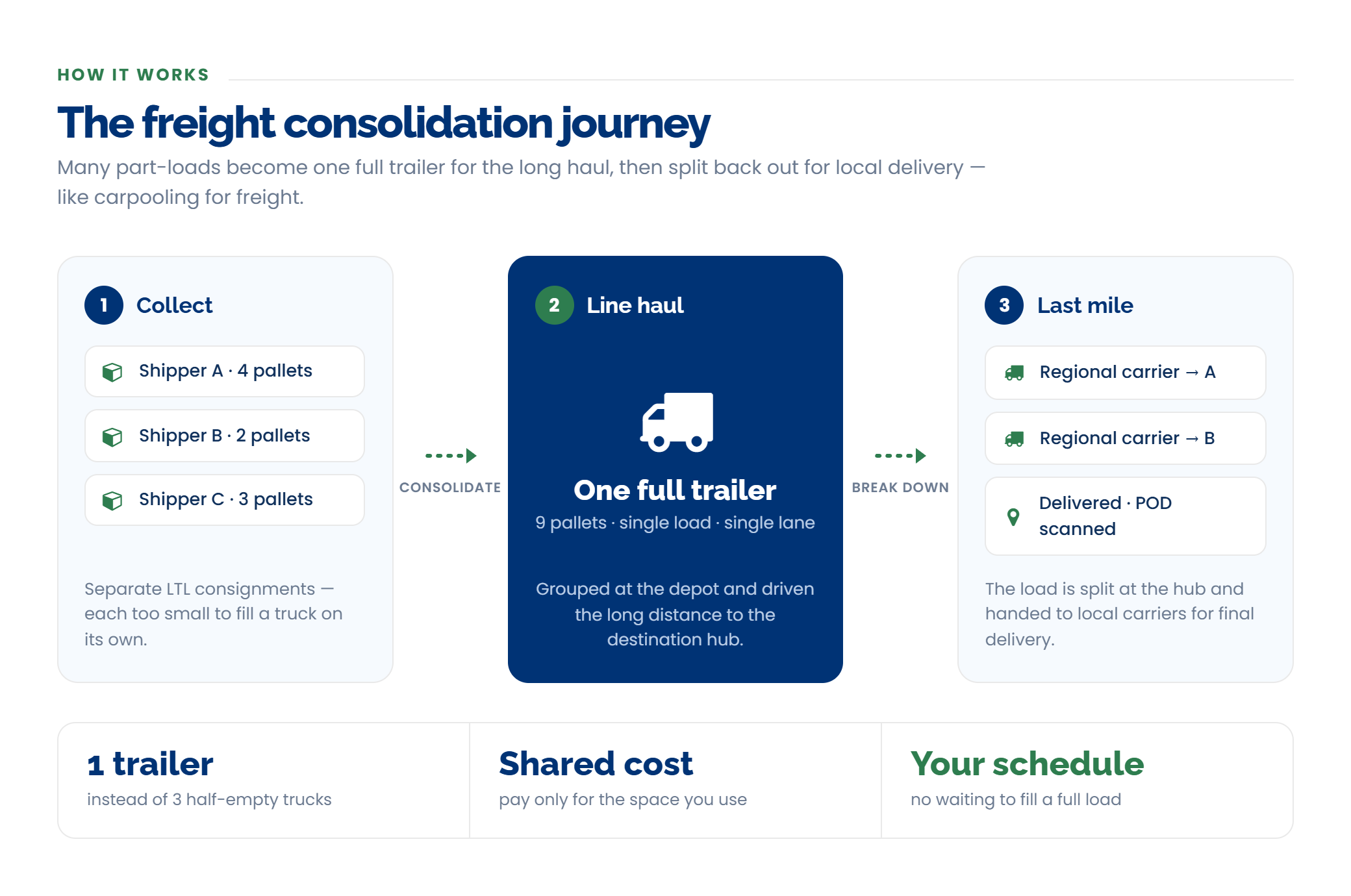
Consolidated freight is the practice of combining multiple shipments into a single load — all heading to the same destination.
Instead of sending half-empty trucks down the same route, consignments are grouped together to fill trailer capacity. Once the load reaches its destination hub, it's broken down and distributed by regional carriers for last-mile delivery.
Think of it like carpooling for freight. Everyone shares the ride. Everyone splits the cost.
It's especially valuable for businesses shipping less-than-truckload (LTL) volumes. No more paying for space you're not using. No more holding shipments until you have a full load. You ship on your schedule — at a fraction of the cost.
Benefits of Freight Consolidation
Cost Saving
Shipping a partial load? You're still paying for the whole truck.
Consolidated freight shipping fixes that. You only pay for the space you use. Bulk rates drop your per-unit cost. And fewer trucks on the road means lower overheads long-term.
Faster Transit Times
Fewer stops. Fewer handling points. Freight moves directly to the destination hub before final delivery. Less opportunity for delays. More predictable ETAs.
Reduced Environmental Impact
Fewer trucks. Fewer trips. Lower emissions. For businesses with sustainability targets, consolidated shipment is a practical, measurable win.
Better Customer Satisfaction
Late deliveries damage trust. Consolidation means you're not waiting to fill a truck before you ship. You meet deadlines consistently — without the cost of running half-empty vehicles.
Greater Flexibility
Ship smaller volumes on a regular cadence. No waiting for a full load. Particularly useful for businesses with fluctuating order volumes or tight seasonal windows.
More Visibility and Control
Track loads in real time. Get alerts when something changes. Know where every consignment is — without chasing carriers for updates.

💡 That's six ways consolidation pays off. Now see what it looks like for your freight. Reach out to us and find out how Transvirtual can help.
Who Should Use Freight Consolidation?
It's a strong fit if you:
- Regularly ship LTL volumes
- Need to cut freight costs without sacrificing speed
- Want better visibility over outbound shipments
- Ship oversized (or "ugly" freight)
- Struggle to meet delivery deadlines due to load constraints
- Have sustainability targets to hit
Manufacturers, retailers, 3PLs, freight brokers — if volume and cost efficiency matter, consolidation belongs in your operation.
How to Get Started
Freight consolidation works best when it is built directly into your freight management system.
Transvirtual helps freight operators identify consolidation opportunities, combine compatible consignments, and manage freight movements from dispatch through to delivery within a single platform.
With automation, real-time tracking, and connected carrier workflows, teams spend less time managing freight manually and more time improving load efficiency and delivery performance.
Dispatch software helps you manage and coordinate your delivery operations from one central system. It handles scheduling, assigns drivers or carriers, plans routes, tracks vehicles in real time, and manages proof of delivery. It also automates admin tasks like updates, billing, and reporting so your team can work faster and with fewer errors.
A dispatch manager is responsible for organising and overseeing the movement of goods. They schedule pickups and deliveries, assign drivers or carriers, monitor routes, respond to delays or issues, and keep customers updated. With dispatch software, much of this work becomes easier because the system provides real-time visibility and automates many manual steps.
Because it makes your delivery operations more efficient and cost-effective. You get real-time visibility, fewer delays, automated scheduling, and better route planning. This leads to lower costs, quicker deliveries, happier customers, and easier scaling as your business grows. It removes guesswork and replaces it with automation and data-driven decisions.
Businesses that move goods or coordinate drivers use dispatch software, including transport companies, courier and last-mile delivery providers, freight operators, warehouses, and fleet managers. Any organisation that needs to schedule, track, and manage deliveries can benefit from it.