
 NZ


A transport management system (TMS) is software that helps businesses plan, execute, and optimise the physical movement of goods across their supply chain.
Now, we all know that transportation is one of the key processes in the supply chain. It consists of various activities, from planning deliveries to issuing invoices.
Most, if not all, companies strive to maximise profitability through proper logistics management. This involves hiring a team of experts and employing a transport management solution to automate tasks for you.
In this article, we'll explore transport management systems and how they address the many logistical challenges that businesses face today.
What is a Transport Management System (TMS)?
For small businesses with few shipments, managing transport operations can be done the old-fashioned way: using spreadsheets and phone calls.
But as you grow, manual task management is no longer feasible. Not to mention, keeping track of thousands of manual paperwork becomes time and resource exhaustive. And to track shipments manually? Impossible!
That's where TMS Software come into play.
Transport management systems or TMS are a type of specialised software that aids in the planning and movement of goods. It's generally designed to increase the efficiency of transport operations while guaranteeing on-time delivery.
What are the Key Features of a Transport Management System?
1. Real-time tracking and visibility
Modern TMS software should offer real-time tracking and visibility, ensuring comprehensive tracking and tracing in every step of the shipment process.
A transport management system should also seamlessly integrate with different carriers, trucking companies, or other delivery services for easy order management. These integrations also allow seamless shipment tracking and invoicing without the need for constant human intervention.
Speaking of, leveraging modern tech such as GPS devices and mobile barcodes allows businesses to monitor their shipment's whereabouts and condition.
In addition to real time visibility, a modern transport management system should provide advanced analytics, business intelligence, and reporting capabilities. Businesses can then leverage historical transportation data to identify trends and improve delivery performance.
2. Powerful planning features
Transportation planning is vital to any successful logistics strategy. A good plan helps you maximise resources, avoid bottlenecks, and enhance safety and compliance.
That said, TMS software should be equipped with planning features such as:
Load planning: A TMS intelligently allocates shipments to available vehicles or drivers, considering their capacity and schedules. This feature ensures that you are maximising your fleet while also minimising costs.
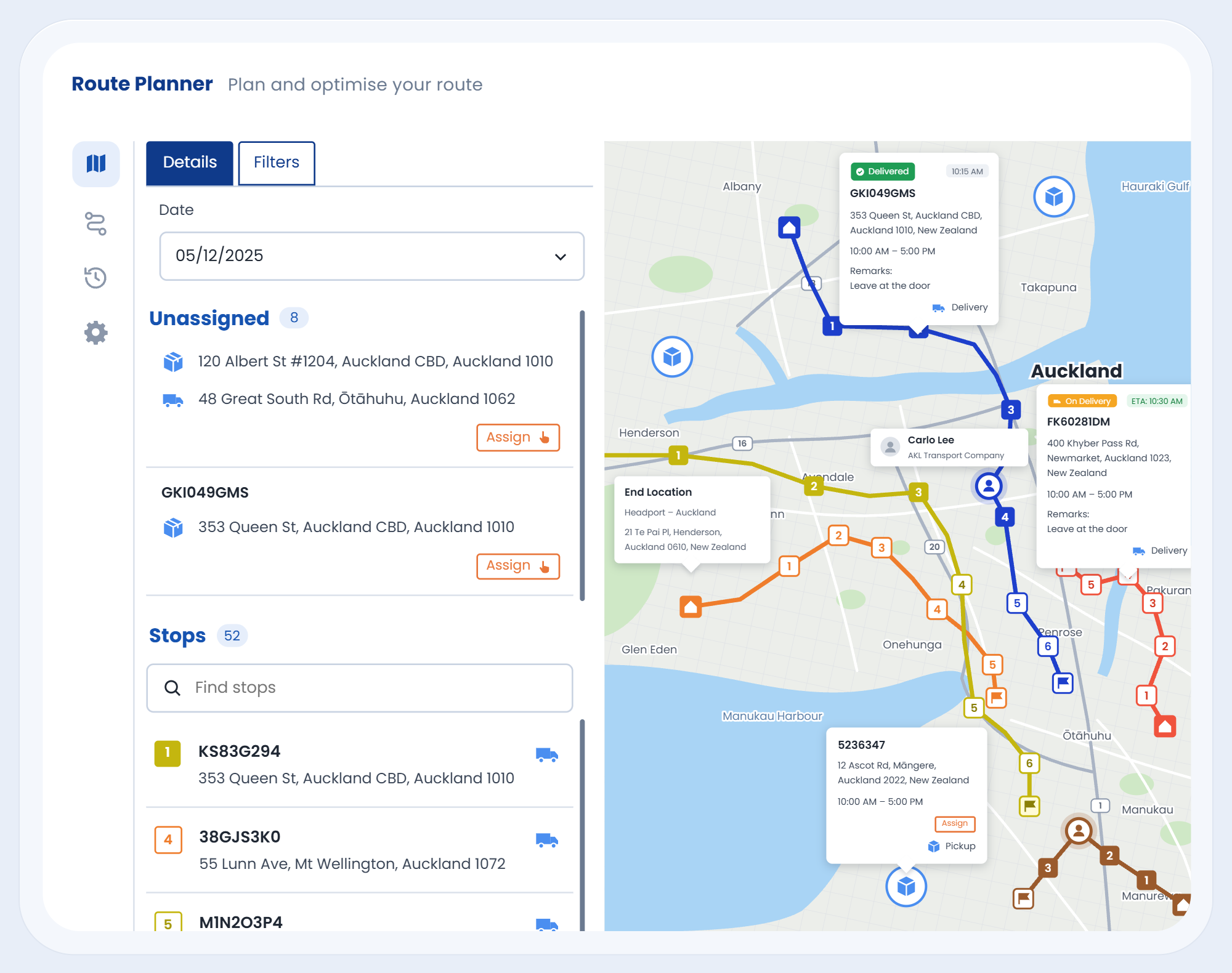
Route optimisation and planning: Dynamic route planning customises delivery routes and stops for specific customers and orders. The system analyses factors such as delivery locations, order volumes, and time windows to ensure efficiency and accuracy.
A transportation management system should help you reduce costs through reliable planning features. Optimising routes and load capacity lowers fuel consumption, fewer road tolls, and faster deliveries.
3. Integration capabilities
Siloed information is enough to devastate transport operations. You need to ensure your platforms can talk – or integrate – with one another.
For example, integrating your TMS software with accounting systems expedites invoicing, transforming time-consuming and messy paper trails into efficient billing processes. This accelerates the order to cash process, consequently improving cash flow.
4. Document management
A transport management system digitises essential documents such as proof of delivery, invoices, manifests, and your bill of lading.
Managing these documents digitally streamlines compliance and allows for better safekeeping and auditing.
5. KPI analytics
Dashboards monitor Key Performance Indicators (KPIs) that give logistics managers real-time visibility into operational performance. A critical inclusion is DIFOT (Delivered In Full, On Time) or OTIF (basically just another way to call DIFOT), which measures the percentage of orders delivered with the correct quantity at the right time.
6. Order management
The Order Management module tracks the entire lifecycle of an order, from creation, confirmation, and allocation through to dispatch, in-transit updates, and final delivery confirmation. It integrates with ERP and WMS platforms to synchronise inventory availability, customer order data, and fulfillment instructions in real time.
This integration ensures that Service Level Agreements (SLAs) and contracted delivery dates are consistently met by automatically flagging exceptions, priority orders, or at-risk shipments. The module also manages documentation such as purchase orders, packing slips, and proof of delivery (POD), and supports multi-stop and multi-leg shipment planning for complex distribution networks.
How Does A Transport Management System Work?

A TMS works as a centralised logistics platform that integrates data from various supply chain partners to plan, execute, and optimise the physical movement of goods.
It typically functions as a comprehensive database containing carrier details, such as pricing, travel times, and capacity, allowing businesses to manage the entire lifecycle of a shipment, from order creation to final payment.
The operational workflow of a TMS generally follows these key stages:
Create
1. Order Received
Once a customer order is placed, the TMS captures and processes the shipment details. Orders can be scanned, organised, and prepared for accurate loading and dispatch.
Allocate
2. Driver/Pickup Assignment
The system matches each job to the right driver based on vehicle type, location, and availability — so no time is wasted on manual coordination.
3. Depot Scanning/Processing
Every shipment gets scanned at the depot, giving you accurate tracking data and ensuring nothing slips through the cracks.
4. Route Planning
A TMS automatically calculates the most efficient delivery routes based on factors like traffic conditions, distance, delivery windows, and fuel costs. This helps reduce delays and improve operational efficiency.
5. Runsheet and Manifest Creation
Before drivers hit the road, they're equipped with clear runsheets and manifests, so everyone knows exactly what to pick up, where to go, and when to be there.
Deliver
6. Loading and Delivery via App
Drivers manage their loads and confirm deliveries in real time through a mobile app. The system maximises available fleet space by intelligently allocating consignments and balancing loads across vehicles. This helps reduce empty space and unnecessary trips.
7. Shipment Tracking
A TMS provides real-time shipment tracking so businesses and customers can monitor delivery progress, estimated arrival times, and potential delays.
8. Customer Notifications
Customers receive automatic updates at every key milestone.
Monitoring
9. Invoicing
Once a delivery is complete, invoices are generated automatically. Drivers can confirm deliveries instantly using digital tools like electronic proof of delivery (ePOD) and signature capture. This provides accurate delivery records and improves accountability.
10. Reporting
Performance data gives your team the insights to spot gaps, celebrate wins, and keep improving.
Who Needs Transport Management Software?
TMS solutions are essential for professionals in the logistics and supply chain industry. But they can also extend to businesses from several sectors, including:
- Manufacturers
- Distributors
- Retailers and eCommerce companies
- Logistics service providers

Why is a Transport Management System Important?
Transportation is one of the biggest operational costs for logistics businesses, making efficiency and visibility more important than ever.
At the same time, customer expectations around faster deliveries and real-time tracking continue to grow. This is why many companies are investing in Transport Management Systems (TMS) to streamline operations, reduce costs, and improve supply chain performance.
Improves operational efficiency
A TMS automates time-consuming logistics tasks like dispatching, route planning, shipment tracking, and carrier communication. This reduces manual work and helps teams operate faster with fewer errors.
Reduces transportation costs
Transportation is one of the biggest supply chain expenses. A TMS helps businesses lower costs through route optimisation, load planning, freight auditing, and smarter carrier selection.
Provides real-time visibility
A TMS gives businesses live updates on shipments, deliveries, and fleet movements. This visibility helps teams respond quickly to delays, disruptions, or customer enquiries. Using control tower visibility and decision support.
Real-time data also enables proactive exception management, meaning issues are identified and resolved before they impact delivery performance or customer satisfaction.
Enhances Customer Service
Customers expect accurate delivery updates and faster response times. They look at delivery windows when choosing to buy. Real-time delivery tracking is an important customer satisfaction factor.
With a TMS, businesses can provide better communication, accurate ETAs, and improved delivery performance. Customers stop buying from a brand after experiencing poor delivery, making consistent, visible delivery performance a direct driver of customer retention and revenue
Supports Better Decision-Making
TMS platforms provide reporting and analytics that help businesses track performance, identify inefficiencies, and make data-driven logistics decisions.
Simplifies Carrier Management
Managing multiple carriers manually can become complicated. A TMS centralises carrier information, rates, performance tracking, and communication in one platform.
Improves Route Optimisation
A TMS helps identify the most efficient delivery routes, reducing fuel usage, travel time, and unnecessary mileage while improving delivery schedules.
Increases Scalability
As businesses grow, transportation operations become more complex. A TMS helps companies scale without dramatically increasing manual processes or operational overhead. TMS automation helps carriers handle more volume without a proportional increase in resources, allowing operations to expand across new lanes, markets, or carrier relationships without adding headcount.
The growing adoption of SaaS-based TMS platforms makes this scalability cost-effective and flexible, allowing businesses of all sizes to access enterprise-grade functionality without large upfront infrastructure investment.
Strengthens Supply Chain Coordination
A TMS connects different parts of the supply chain, helping warehouses, carriers, dispatchers, and customers stay aligned through shared information and streamlined communication.
A TMS acts as the connective layer that ensures data flows seamlessly between ERP systems, WMS platforms, carriers, and customers, reducing siloed communication and improving end-to-end supply chain performance.
What Are the Different Types of TMS?
| Type | Key Features | Best For |
|---|---|---|
| On-Premise TMS | Installed locally with high control and customisation. Requires internal IT support and ongoing maintenance. | Large businesses that need strict data control and highly customised workflows. |
| Cloud-Based TMS (SaaS) | Hosted online, scalable, and easy to deploy. Updates and maintenance are managed by the provider. | Growing businesses looking for flexibility, lower upfront costs, and faster implementation. |
| Enterprise TMS | Advanced system with deep integrations across ERP, WMS, and supply chain platforms. | Large enterprises managing complex logistics operations and high shipment volumes. |
| Standalone TMS | Focused primarily on transport management without extensive integrations. | Small to medium-sized businesses needing simple and cost-effective transport management. |
| Integrated TMS | Connects with inventory, warehouse, and order management systems for end-to-end visibility. | Businesses wanting a connected supply chain and centralised operations. |
| Best-of-Breed TMS | Specialised tools designed for functions like routing, freight audit, or carrier management. | Businesses looking for advanced features in a specific area without adopting a full suite. |
Not all TMS platforms are built the same. The right one for your business depends on your size, shipping volume, and how much control you need over your logistics.
1. On-Premise TMS
This type is installed locally on a company’s servers. It offers full control and customisation but requires higher upfront costs and ongoing IT maintenance.
2. Cloud-Based TMS (SaaS)
A cloud TMS is hosted online and accessed through a browser. It’s scalable, cost-effective, and easier to implement. Updates and maintenance are handled by the provider.
3. Enterprise TMS
Designed for large organisations with complex supply chains, an enterprise TMS integrates deeply with ERP, WMS, and other logistics systems.
4. Standalone TMS
This type focuses purely on transport management without heavy integration into other business systems. It’s often used by smaller businesses.
5. Integrated TMS
An integrated system connects with other platforms like inventory, warehouse, and order management systems to give a full end-to-end supply chain view.
6. Best-of-Breed TMS
Instead of using one large suite, businesses choose specialised TMS tools that excel in specific areas like routing, freight audit, or carrier management.
Cloud-Based Transport Management Systems
A cloud-based TMS provides value to an already robust system. They deliver the same benefits as other cloud solutions, including scalability, cost efficiency, and faster ROI. For organisations seeking greater flexibility, hybrid cloud solutions can complement cloud-based TMS by allowing sensitive data or critical operations to remain on-premise while leveraging the cloud for scalability and innovation
What's more, cloud based TMS offer improved business continuity with backups stored in geographically dispersed data centers. This protects your data in case of natural disasters, hardware failures, and other unforeseen events.
What is the Difference Between TMS Software and a Warehouse Management System?

Both TMS solutions and warehouse management systems play a critical role in supply chain management. They serve different functions but work together to ensure the efficient flow of goods.
As their names imply, a warehouse management system streamlines the storage, movement, and handling of goods within a warehouse. Think inventory management and receiving processes.
A transport management system, on the other hand, is used to plan, execute, and optimise the physical movement of goods. Simply put, it's there to help you manage transportation operations. Features include route planning and optimisation, carrier management, freight management and freight billing, and performance metrics.


 Visit our US site