
 NZ
NZ
What is 1PL (first-party logistics)?
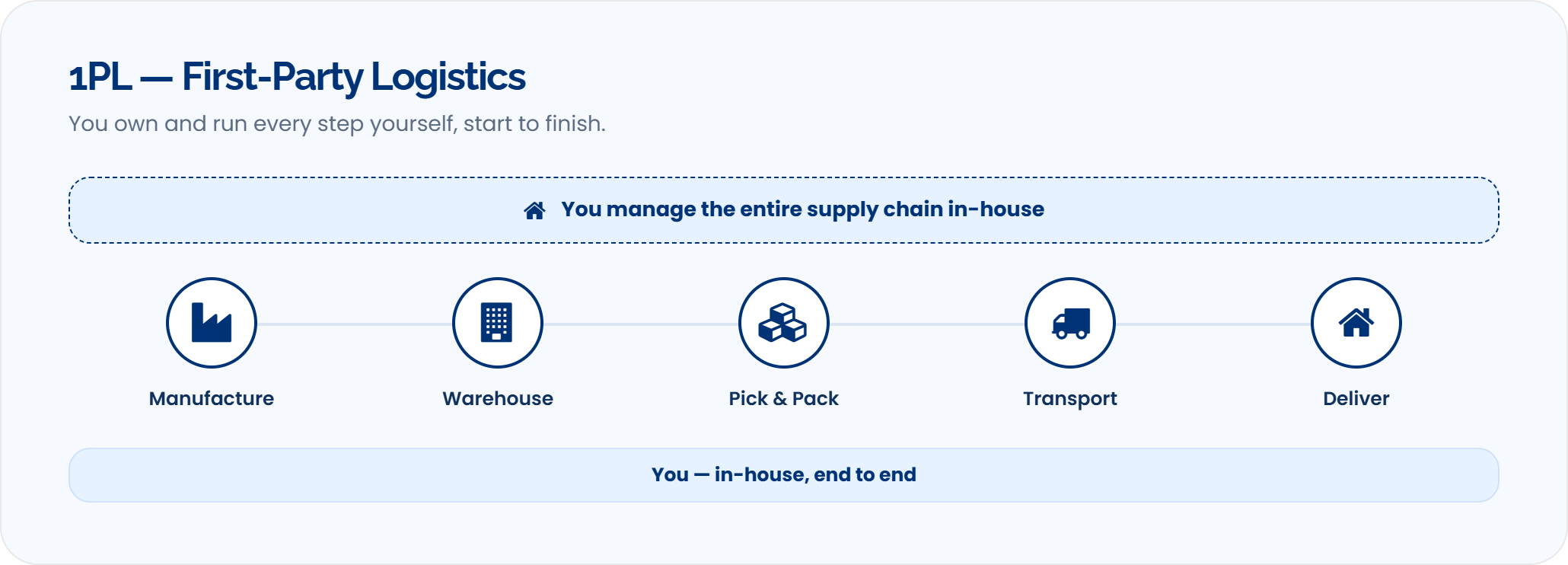
First-party logistics (1PL) is the simplest logistics model. In this setup, a business manages every aspect of its own logistics operations without relying on an external logistics provider.
The company owns or leases its own warehouse and transportation assets, hires its own drivers, manages inventory, and oversees deliveries from start to finish. There are no intermediaries involved — logistics stays a core business function rather than something handed off to a third party provider.
Small manufacturers, local farms, construction companies, and businesses that deliver products within a limited geographic area commonly operate as 1PL organizations.
How 1PL works
Imagine a local bakery that delivers cakes using its own delivery vans and employees. The bakery purchases the vehicles, plans delivery routes, maintains the fleet, schedules drivers, and communicates directly with customers.
Everything stays under the company's control. This approach works well for businesses with predictable delivery volumes and relatively simple logistics requirements.
Advantages of 1PL
One of the biggest advantages of 1PL is complete control. Businesses make all operational decisions, manage customer interactions directly, and maintain full visibility over their inventory and deliveries.
Other benefits include:
Greater control over customer service
Direct oversight of delivery quality
Faster decision-making
Stronger brand consistency during deliveries
Disadvantages of 1PL
While maintaining control has its benefits, managing logistics internally can quickly become expensive as a business grows.
Companies must invest in physical assets like vehicles, drivers, insurance, maintenance, fuel, technology, and compliance. As delivery volumes increase, these costs often rise faster than revenue. Scaling operations can also be challenging without dedicated logistics expertise or in house logistics know-how.
Best for:
Small local businesses
Companies with simple delivery operations
Organizations with sufficient logistics resources
What is 2PL (second-party logistics)?
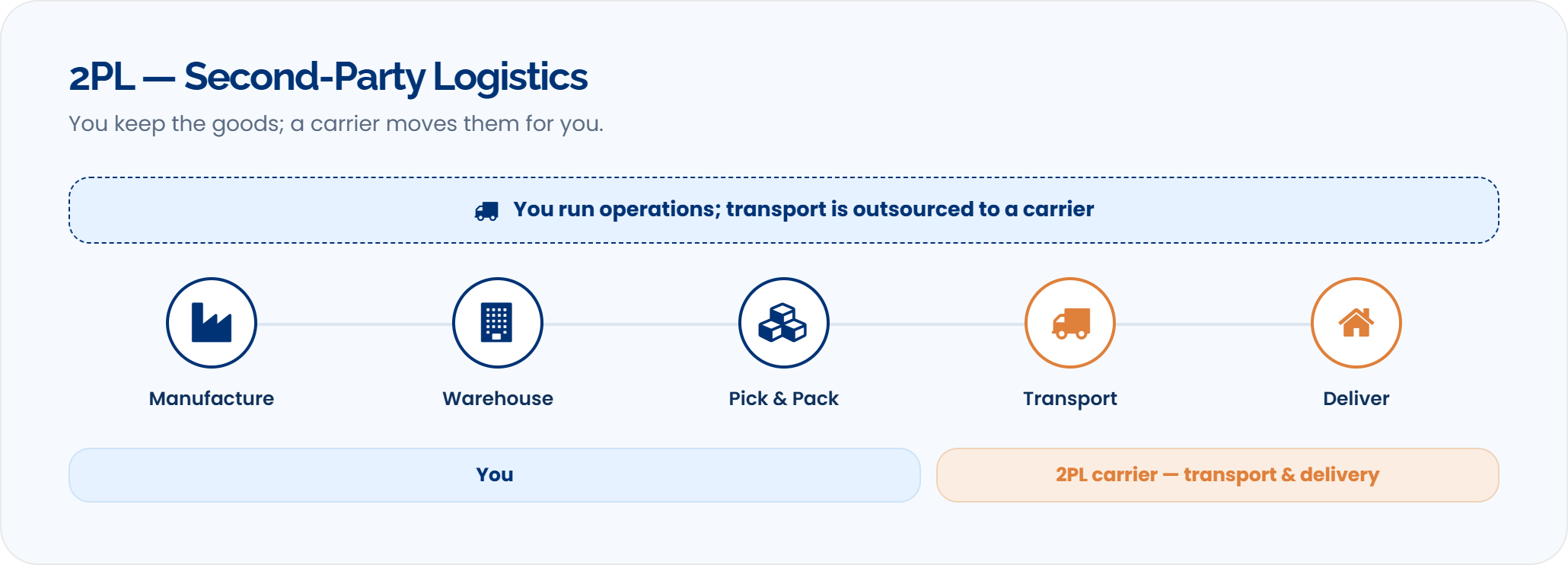
Second-party logistics (2PL) involves outsourcing transportation services to a company that owns logistics assets such as trucks, ships, trains, or aircraft — often referred to as an asset based carrier.
Unlike 1PL, businesses no longer operate their own transport fleet. Instead, they hire transportation providers to move goods between locations while retaining responsibility for managing the broader supply chain processes. The 2PL provider focuses on transportation rather than end-to-end logistics management, which is what separates second party logistics services from a full third party logistics company.
How 2PL works
Suppose a manufacturer needs to move products from its warehouse to regional distribution centers across the country.
Rather than purchasing trucks and hiring drivers, the manufacturer contracts a trucking company to transport the goods. The manufacturer still manages inventory, warehousing, customer relationships, and order planning, while the carrier handles transportation.
This arrangement allows businesses to reduce capital investment without giving up complete control over logistics planning or their broader negotiation logistics strategy with carriers.
Advantages of 2PL
Working with a transportation provider eliminates many of the costs associated with owning a fleet.
Benefits include:
Lower capital investment
Access to professional carriers
Flexible transportation capacity
Reduced fleet maintenance costs
Improved delivery coverage
Disadvantages of 2PL
Although transportation becomes easier, businesses remain responsible for coordinating multiple logistics functions themselves. They may also have limited visibility into shipments if carriers don't provide modern tracking technology, such as global positioning system data on vehicle location. Communication between multiple transport providers can become another challenge as operations grow.
Best for:
Manufacturers
Retailers
Importers and exporters
Businesses with internal logistics teams
What is 3PL (third-party logistics)?
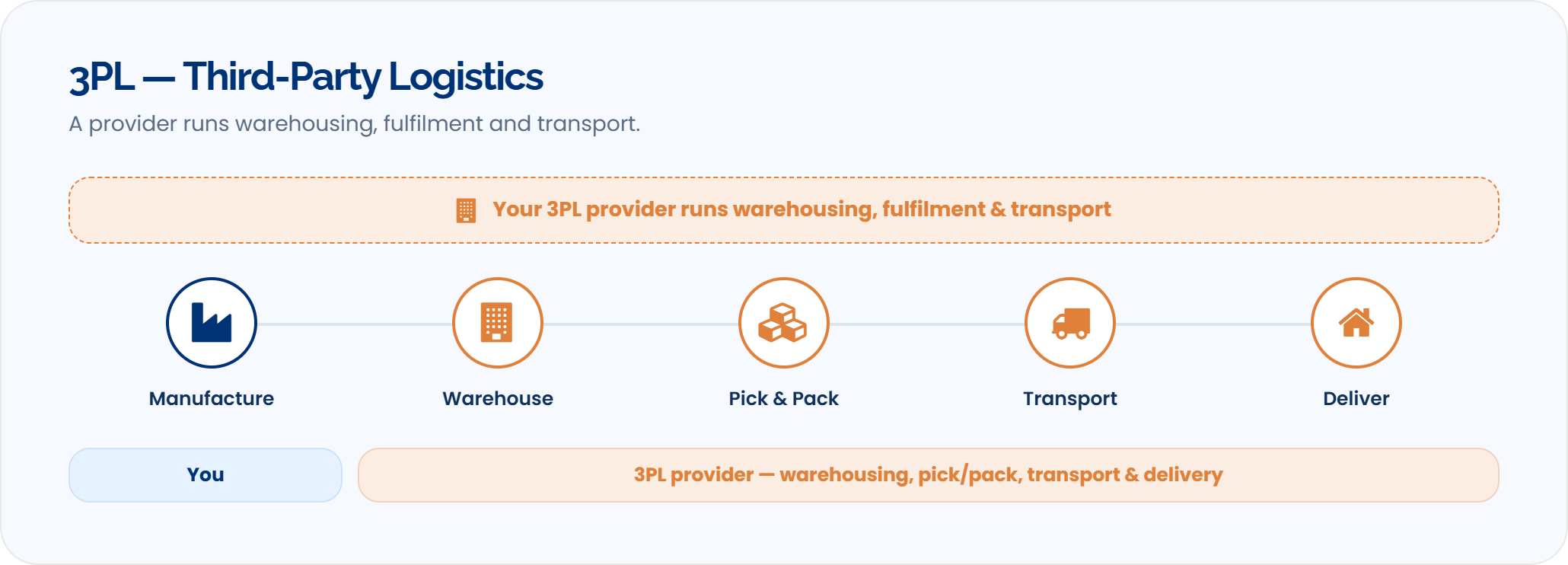
Third-party logistics (3PL) providers manage a much broader range of logistics services than transportation alone. Instead of simply moving freight, a third party logistics provider becomes an operational extension of a business by handling warehousing, transportation, inventory management, order fulfillment, freight coordination, and reverse logistics.
Today, many businesses rely on a third party logistics company to simplify operations, achieve cost savings, and improve customer satisfaction without having to build large internal logistics departments.
According to industry research, outsourcing logistics can help organizations improve operational flexibility while allowing them to focus on core competencies like product development, sales, and customer relationships — rather than getting pulled into the day-to-day of controlling shipping costs and managing warehouse space.
What services does a 3PL provider offer?
Although services vary between providers, a typical third party provider can manage:
Freight transportation
Warehouse operations
Inventory management
Order fulfillment
Pick and pack services
Reverse logistics and returns
Customs documentation
Freight brokerage
Cross-docking
Carrier coordination
Many 3PL providers also offer value-added services such as packaging, labeling, kitting, and inventory forecasting through a dedicated fulfillment center.
How 3PL works
Consider an eCommerce retailer experiencing rapid growth across multiple sales channels.
Instead of leasing warehouses, hiring warehouse staff, managing transport providers, and coordinating deliveries, the retailer partners with a 3PL. Orders are automatically sent to the fulfillment center, where products are picked, packed, shipped, and tracked. The retailer receives visibility into inventory and shipment status while focusing on marketing, customer service, and growing the business.
This allows businesses to scale much faster than managing logistics independently, and to expand into multiple markets without building out an entire logistics department from scratch.
Advantages of 3PL
For many organizations, outsourcing logistics to a 3PL provides significant operational and financial benefits.
Key advantages include:
Lower operating costs and shipping costs
Access to logistics expertise
Scalable operations during peak demand
Faster delivery times
Better inventory management
Reduced capital investment
Improved customer satisfaction
Greater geographic reach
Many 3PL providers, including major names like DHL Supply Chain, also invest in advanced logistics technology such as warehouse management software, giving customers access to tools that would otherwise require significant investment.
Challenges of 3PL
Despite the benefits, choosing the wrong logistics partner can create operational challenges. This is often where the "3PL vs" comparison conversation starts — 3PL vs 4PL, 3PL vs in-house, 3PL vs 2PL — because the right fit depends entirely on your supply chain efficiency goals.
Businesses should carefully evaluate service quality, technology capabilities, reporting, communication, and scalability before selecting a provider. As operations become more complex, many 3PLs also need sophisticated technology to coordinate carriers, automate workflows, optimize transport planning, and provide customers with real-time shipment visibility.
What is 4PL (fourth-party logistics)?
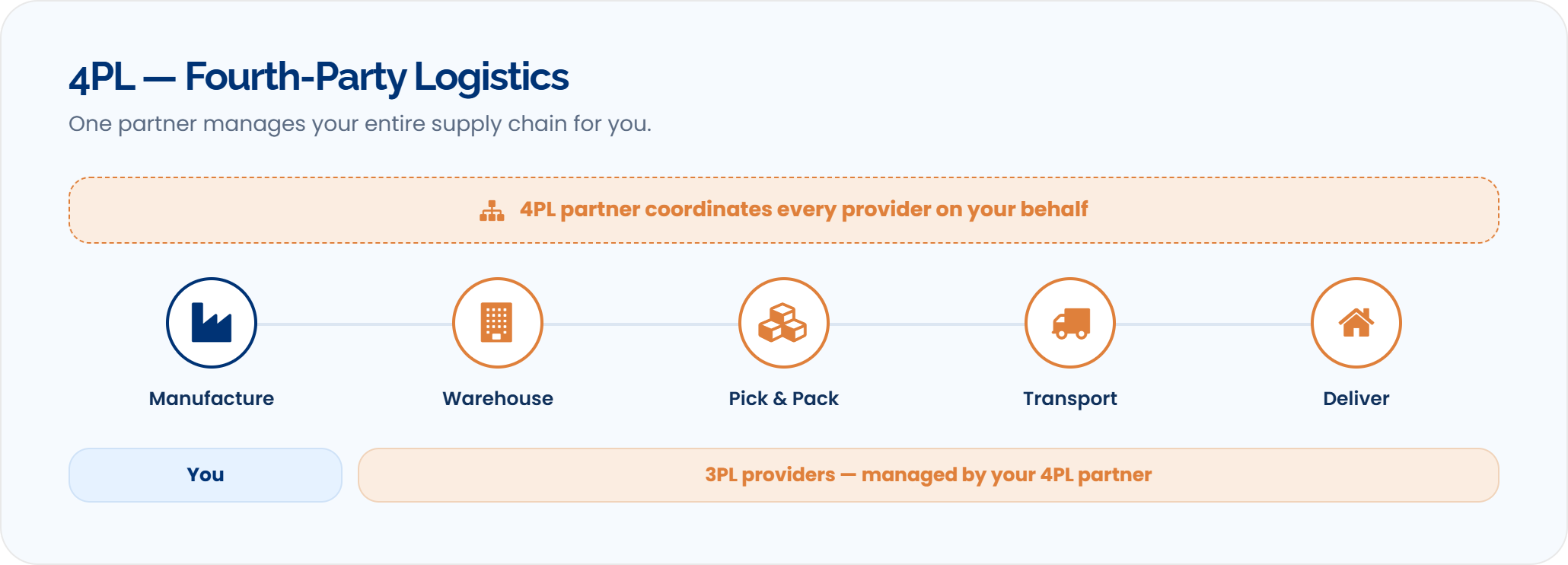
Fourth-party logistics (4PL) takes logistics outsourcing a step further than 3PL. Instead of managing day-to-day transportation and warehousing, a fourth party logistics provider oversees the entire logistics process on behalf of a business. Acting as a strategic partner, a 4PL coordinates multiple logistics providers, carriers, warehouses, and suppliers to ensure every part of the supply chain works together efficiently.
Rather than owning transportation assets, many 4PL and party logistics provider models focus on planning, optimization, and supply chain visibility. These are often described as lead logistics providers, since they sit above individual carriers and 3PLs and provide strategic oversight of the whole network. They use technology, data analytics, and industry expertise to improve performance, reduce costs, and help businesses make informed decisions.
How 4PL works
Imagine a retailer selling products across Australia and New Zealand. Instead of working directly with several freight carriers, warehouse operators, and customs brokers, the retailer partners with a 4PL provider.
The 4PL manages these relationships, monitors shipment performance, optimizes transportation management strategies, and provides a single point of contact for the entire supply chain. To achieve this level of integrated services, most 4PLs rely on Transport Management Systems (TMS) and supply chain visibility tools that centralize logistics operations and track key performance indicators across every partner involved.
Benefits of 4PL
Businesses often choose a 4PL when their supply chains become too complex to manage internally. A strategic logistics partner can deliver several advantages, including:
End-to-end supply chain visibility
Improved collaboration across multiple logistics providers and service providers
Better transportation planning
Lower operational costs
Data-driven decision-making
Greater scalability as the business grows into multiple markets
Improved customer service and delivery performance
By overseeing the entire logistics network, 4PL providers can identify inefficiencies and recommend improvements that individual carriers may not be able to see.
Challenges of 4PL
Entrusting one provider with your entire supply chain requires a high level of trust and transparency. Businesses should ensure their 4PL partner has the technology, experience, and reporting capabilities needed to support long-term growth and consistent strategic oversight.
What is 5PL (fifth-party logistics)?
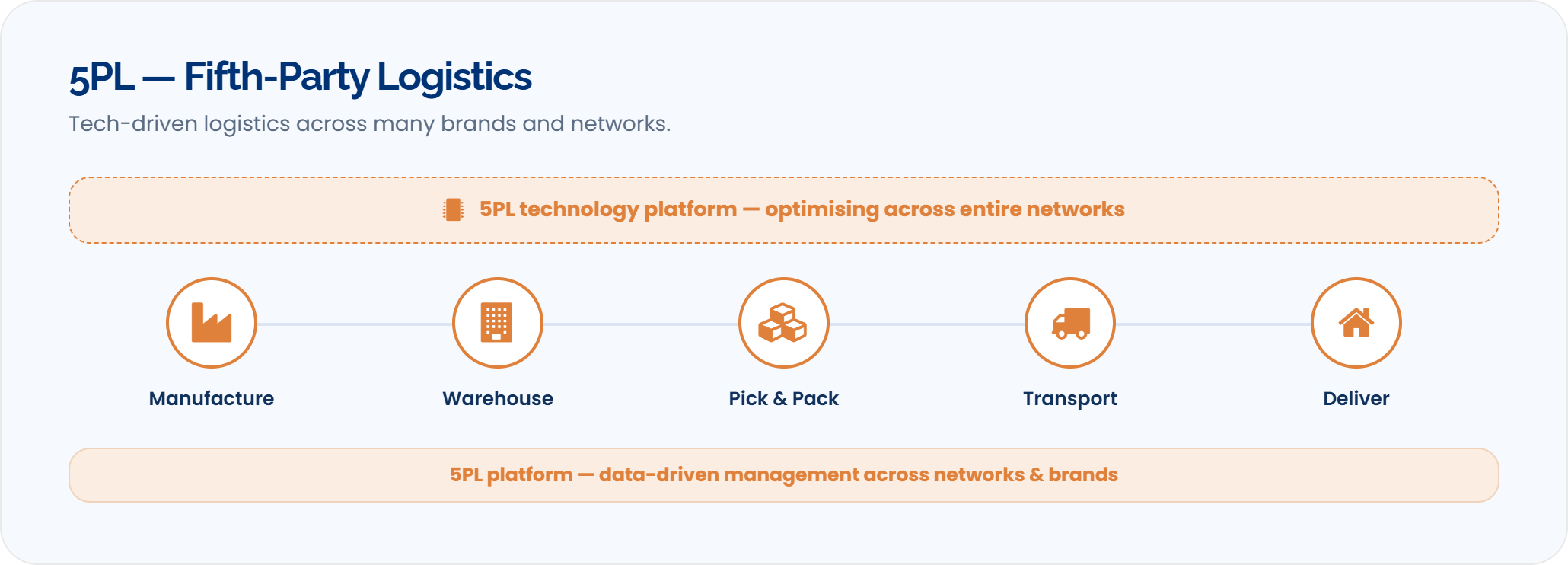
Fifth-party logistics (5PL) represents the most advanced logistics model. While a 4PL manages a company's supply chain, a 5PL focuses on optimizing entire logistics networks using digital technology, automation, artificial intelligence (AI), and data analytics.
5PL providers typically manage logistics across multiple organizations, coordinating complex supply chain operations on a much larger scale. Their goal is to maximize efficiency, reduce transportation costs, and improve supply chain performance through intelligent planning and modern logistics strategies.
As global supply chains become increasingly connected, 5PL providers are playing a growing role in helping businesses adapt to changing customer expectations and market conditions.
How 5PL works
A global eCommerce marketplace may work with dozens of freight forwarders, warehouse providers, ocean carriers, and last-mile delivery companies across several countries.
Rather than managing each relationship separately, the business partners with a 5PL logistics company that uses advanced technology — from global positioning system tracking to predictive analytics — to coordinate every stage of the supply chain. AI-powered planning and automated decision-making help optimize freight movements while improving delivery performance.
Benefits of 5PL
As logistics networks become more complex, 5PL providers help businesses improve efficiency through technology and automation.
Key benefits include:
AI-powered logistics planning
Greater supply chain visibility
Improved operational efficiency
Lower transportation and administrative costs
Better scalability
Faster decision-making
Enhanced collaboration across multiple logistics providers
Continuous supply chain optimization
Challenges of 5PL
Implementing a 5PL strategy often requires significant investment in technology and digital transformation. Businesses may also need to integrate multiple systems, standardize data, and redesign existing logistics processes.
Choosing a technology partner with robust integration capabilities and scalable logistics software is essential for maximizing the benefits of a 5PL model.
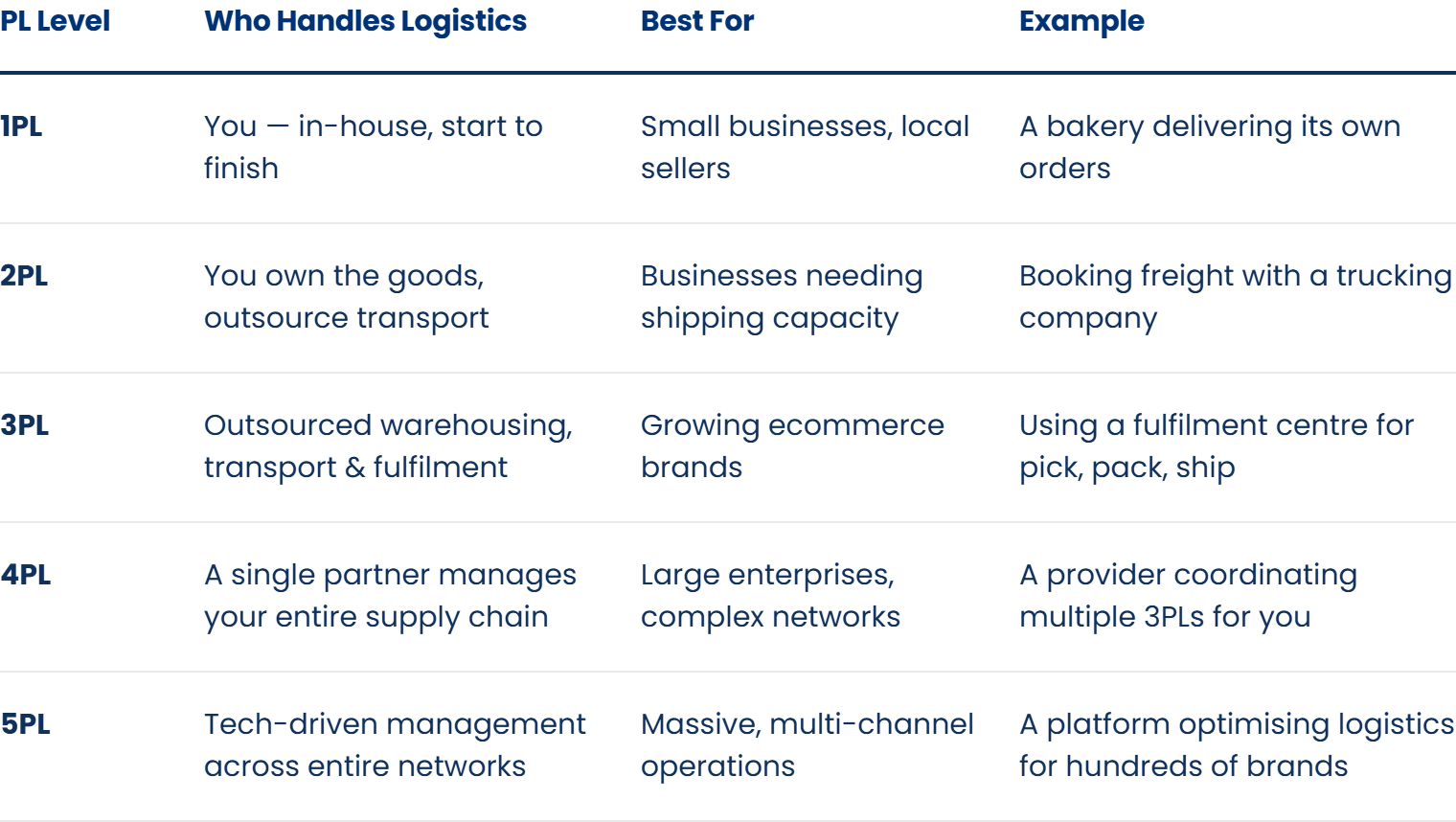
Key Differences Between 1PL, 2PL, 3PL, 4PL, and 5PL at a Glance

 Visit our US site