
 NZ
NZ
If you've researched supply chain software, you've likely seen two tools come up: Transport Management Systems (TMS) and Freight Management Software (FMS). They look similar on the surface. But they serve different purposes. Choosing the wrong one can create serious gaps in your operations.
Here's a clear breakdown to help you decide.
What Is the Main Difference Between a TMS and an FMS?
The core distinction comes down to scope.
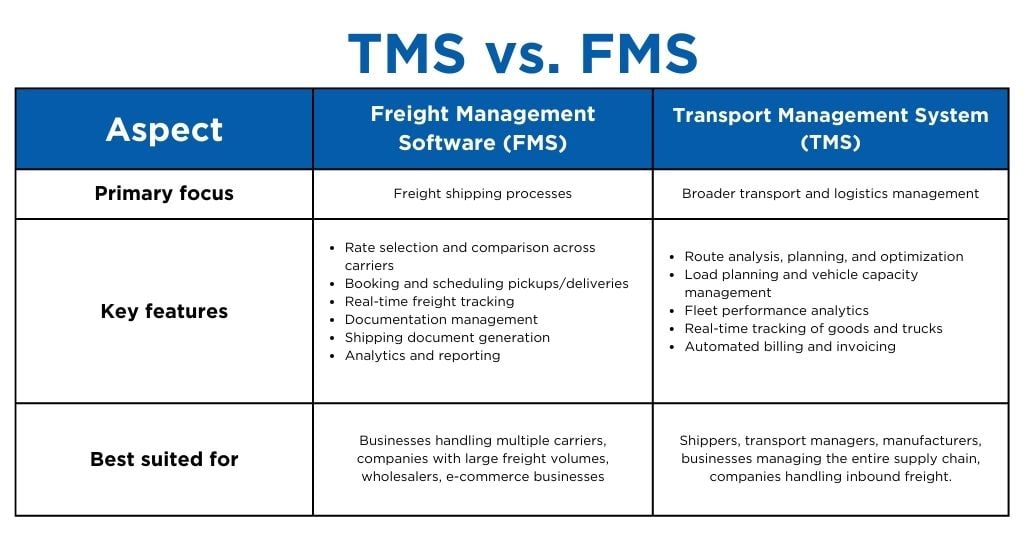
A TMS manages your entire transportation operation. This includes your fleet, drivers, third-party carriers, route planning, and load planning. It's built for businesses that oversee the movement of goods.
An FMS focuses on freight shipping. It helps you manage freight bookings, carrier relationships, and shipping documentation like invoices and bills of lading. It also handles freight-level tracking and reporting.
A TMS controls how goods move. An FMS controls how freight is booked and managed.
When Does a Business Need an FMS Over a TMS?
It depends on how your business operates.
An FMS suits your business if you use external freight carriers, ship large freight volumes, or work with multiple carriers. Wholesalers, e-commerce retailers, and distributors are common FMS users.
A TMS suits your business if you run your own fleet, manage inbound and outbound logistics, or need full visibility across your entire transport operation. Shippers, transport managers, and manufacturers are common TMS users.
Many larger businesses use both. The FMS manages carrier relationships and freight tasks. The TMS handles route optimisation, load planning, and fleet performance. Together, they cover the full logistics operation.
Comparing Freight Management Systems vs. Transport Management Systems
Let’s start with what they both do. A Transportation Management System (TMS) plays a critical role in managing logistics operations effectively. An FMS can improve transportation efficiency and profitability. When used together, they help businesses fulfill their transportation and logistics needs.
What Are the Key Features of a TMS?
A Transport Management System includes:
- Route analysis, planning, and optimisation
- Load planning to maximise vehicle capacity
- Real-time tracking of goods and vehicles
- Automated billing and invoicing
- Analytics and fleet performance reporting
For a full breakdown, visit our Transport Management Software page.
What Are the Key Features of an FMS?
A Freight Management System includes:
- Carrier rate comparison across multiple carriers
- Freight booking and delivery scheduling
- Real-time freight tracking
- Document generation including invoices and bills of lading
- Reporting and analytics for freight decisions
For more details, visit our Freight Management Software page.
Choosing the Right System
Choosing the right system for your business depends on your specific needs and goals. If you are looking for a system that can handle the entire transportation and logistics process, a TMS may be the better choice. However, if you need a system that focuses specifically on freight shipping, an FMS may be the way to go.
Factors to Consider When Choosing an FMS vs TMS
When choosing between a TMS and an FMS, there are several factors to consider. These include:
The scope of your logistics operations: If you need to manage the entire transportation and logistics process, a TMS may be the better choice. However, if you only need to manage freight shipping, an FMS may be sufficient.
The complexity of your operations: If you have complex logistics operations, a TMS may be better equipped to handle your needs. However, if your operations are relatively simple, an FMS may be sufficient.
Your budget: TMS and FMS can vary significantly in terms of cost. If you have a limited budget, an FMS may be the more affordable option.
Impact on Business Operations and Efficiency
Implementing a TMS or FMS can have a significant impact on business operations and efficiency. Both systems can help streamline logistics and transportation processes, reduce costs, and improve customer satisfaction.
However, the impact of a TMS or FMS will depend on the specific needs and goals of your business. If you choose the right system for your business, you can expect to see improvements in operational efficiency, reduced costs, and improved customer satisfaction.
FMS or TMS: We Can Help
Transvirtual can help you determine which logistics software has the capabilities to meet your needs. We offer a zero-commitment strategy session where we discuss your biggest logistics challenges and propose the best solutions for them.
Schedule a call at your convenient time today!

 Visit our US site