
 US
US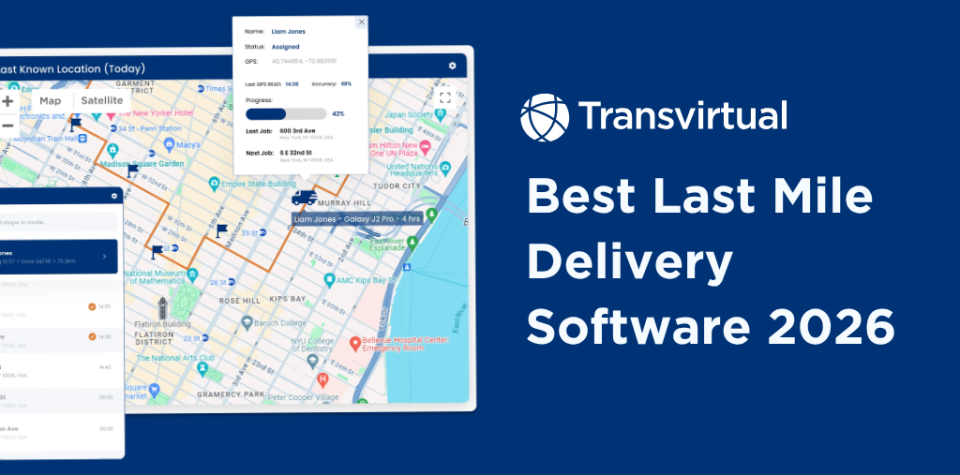
Table of Contents
Last-mile delivery is the most complex part of the supply chain.
It's the drop off at the front door, the text that says your order has arrived, and the driver who shows up on time. These days, 90% of consumers expect 2-3 day shipping as standard. Get it right and you build customer satisfaction and repeat business. Get it wrong and you lose customers to competitors who offer same day delivery, real time tracking, and accurate delivery time windows.
For delivery businesses in the USA, choosing the right last mile delivery software isn't just a nice-to-have. Rising fuel costs, tighter delivery time windows, and growing customer expectations mean that manual route planning, siloed data, and spreadsheet-based dispatching can no longer keep up. The right last mile delivery solution gives you real time visibility over your delivery vehicle fleet, automated dispatching, and route optimization that actually reduces fuel consumption and operational costs.
This guide breaks down the best last mile delivery software for 2026, so you can find a platform that fits your delivery operations, whether you run your own fleets or contract out to independent drivers.
What is Last Mile Delivery Software?
Last mile delivery management software is a platform built to manage and optimize the final leg of the delivery process, from your warehouse or distribution hub to the customer's door.
At its core, last mile delivery software helps delivery businesses:
Plan efficient delivery routes
Monitor driver shifts and rest periods
Provide accurate delivery time estimates
Send automated customer delivery notifications
Most platforms also include a driver app for proof of delivery, GPS tracking, and two-way customer communication, which together improve delivery accuracy and reduce delivery errors.
Key Features to Look for in Last Mile Delivery Software
Before comparing platforms, it helps to know what actually separates a genuinely useful delivery management system from a basic tracking app. Look for:
Route optimization that considers traffic conditions and optimisation criteria, not just static mapping
Real-time tracking with GPS visibility across your entire fleet
Electronic proof of delivery, including sign-on-glass and photo capture
Driver app functionality, including turn-by-turn navigation and job updates
Customer notifications with accurate, dynamically updated delivery windows
Integration capability with your existing business systems
Reporting and analytics to track driver performance, delivery success rates, and cost per delivery
Scalability, so the platform can grow from a handful of routes to a national delivery network without needing to be replaced
With those benchmarks in mind, here's how the leading last mile delivery software platforms for 2026 stack up.
The Best Last Mile Delivery Software for 2026
1. Transvirtual
Transvirtual is a cloud-based transport management system with purpose-built last mile delivery software that covers route optimization, real-time tracking, a dedicated driver app, and electronic proof of delivery in one connected platform.
Rather than bolting a delivery tool onto disconnected systems, Transvirtual brings dispatch, consignment management, customer portals, and accounting and reporting together, so operations teams get full visibility without juggling multiple logins.
What sets Transvirtual apart is flexibility. It's built to support fast-growing delivery operations that need to move quickly, while also handling the demands of larger, multi-depot delivery networks that need robust carrier integrations.
Transvirtual uses a per-delivery pricing model instead of per-user subscriptions, with no upfront costs or long-term contracts, so businesses only pay for what they ship and can scale up or down as needed.
Best for: small and mid-sized delivery businesses, growing ecommerce operations, and because of scalable features, Transvirtual also fits enterprise-level delivery networks.
2. Onfleet
Onfleet is a last mile software known for its intuitive driver app and dispatching features. It offers route optimization, live tracking, and automated customer notifications, and is popular with businesses running same-day or scheduled delivery services.
Best for: larger businesses due to to the high price entry point
3. Bringg
Bringg is an enterprise-grade delivery orchestration platform used by large retailers and logistics providers to manage complex, multi-carrier delivery networks. It supports advanced routing logic, fleet management, and integrations across large-scale supply chains.
Best for: large enterprises and retailers managing complex, multi-carrier delivery operations.
4. Route4Me
Route4Me focuses heavily on route planning and route optimization, helping delivery businesses cut driving time and fuel costs. It's been around for a long time and has a strong reputation for its routing algorithms, though it's less of a full delivery management suite than some competitors.
Best for: businesses primarily focused on optimizing driving routes rather than full delivery operations management, larger businesses due to price point
5. DispatchTrack
DispatchTrack is geared toward businesses delivering large or heavy goods, such as furniture, appliances, and building materials, where delivery windows and customer communication are critical. It offers real-time tracking, route optimization, and detailed delivery analytics.
Best for: businesses delivering bulky or big-and-bulky goods that need precise delivery windows.
6. Tookan
Tookan is a delivery management platform aimed at businesses that need an affordable, configurable way to manage dispatch and fleet tracking. It offers route optimization and a driver app, with flexibility to customize workflows for different delivery types.
Best for: small businesses and startups looking for a budget-friendly, configurable delivery management tool.
7. Circuit for Teams
Circuit for Teams grew out of a popular consumer route-planning app and has expanded into a business-focused delivery platform. It's straightforward to set up and use, with solid route optimization and driver tracking features.
Best for: enterprise companies, business with high-volume daily courier runs
8. WorkWave Route Manager
WorkWave Route Manager is built for field service and delivery businesses that need to plan efficient routes across multiple stops and drivers. It integrates with other WorkWave products, making it a natural fit for businesses already using WorkWave's broader software suite.
Best for: service-based and delivery businesses already invested in the WorkWave ecosystem.
9. Track-POD
Track-POD combines route planning, electronic proof of delivery, and live tracking in a single platform aimed at courier and delivery companies. It's known for strong proof of delivery capabilities, including barcode scanning and digital signatures.
Best for: courier and delivery businesses prioritizing robust proof of delivery documentation.
10. Locate2u
Locate2u is a delivery and route optimization platform popular with trade and service businesses as well as couriers. It offers live tracking, automated customer notifications, and route planning designed to be quick to set up.
Best for: trade businesses, service providers, and smaller courier operations wanting fast implementation.
Final Thoughts
Last mile logistics software has moved well beyond simple GPS tracking and tracking delivery status. The platforms leading the market in 2026 combine last mile scheduling, route optimization function, real-time visibility, driver management, proof of delivery, and reporting to give businesses a competitive edge.
For businesses in the US weighing up their options, it's worth testing how each platform handles your actual delivery volume and complexity, not just the sales demo. Transvirtual is built to support that full range, from smaller delivery operations through to enterprise fleets, which is why it tops this list for 2026.
Frequently Asked Questions
Transvirtual is one of the best options for small businesses because it combines a quick, low-friction setup with a pay-per-delivery pricing model, so there's no big upfront cost to get started. Unlike platforms built purely for small-scale use, it also gives small businesses room to grow, with the same route optimization, real-time tracking, and proof of delivery features that support enterprise fleets, so there's no need to switch systems as delivery volume increases.
Pricing varies widely depending on fleet size, feature set, and whether the platform charges per driver, per delivery, or as a flat monthly fee. Most providers offer tiered pricing, so it's best to request a quote based on your specific delivery volume rather than relying on advertised starting prices.
Transvirtual, for example, charges a simple per-delivery fee with no upfront costs or long-term contracts, so businesses only pay for completed deliveries and can scale as needed.
