US
US
As logistics operations become more complex, businesses are turning to technology to improve efficiency, visibility, and control. This shift is part of a broader move toward cloud-based software.
For logistics businesses, the choice often comes down to two options: adopt an existing SaaS solution or invest in custom software development built around specific needs. SaaS offers faster deployment, predictable costs, and ready-made features, while custom software solutions provide greater control, flexibility, and tailored functionality. Neither option is automatically better. The right choice depends on your business operations, budget, resources, and business goals. In this guide, we'll compare both approaches and explain when each makes the most sense for your logistics company.
What Is SaaS Logistics Software?
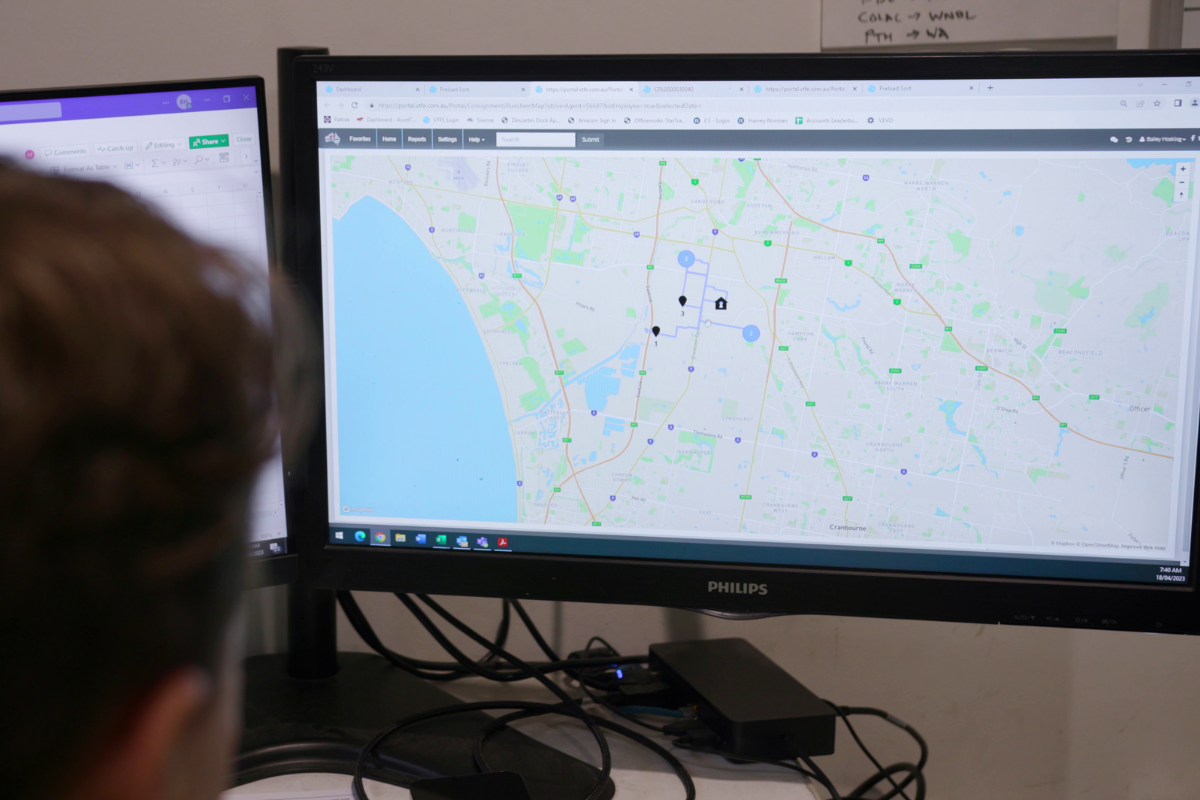
Software as a Service (SaaS) is a software delivery model where applications are hosted by a service provider and accessed over the internet. Instead of purchasing, installing, and maintaining software on your own servers, your business can log in through a web browser or application and use the platform as one of many available SaaS apps.
SaaS logistics software applies this model to transport and logistics operations. It gives businesses access to SaaS tools for managing standard business functions such as shipments, deliveries, dispatching, tracking, documentation, and reporting without requiring them to build and maintain the underlying technology themselves.
Most SaaS logistics platforms operate through a subscription-based business model, with businesses typically paying a monthly or annual fee based on their users, features, or level of usage. This can make the initial investment more predictable and reduce the need for significant IT infrastructure, which is a key reason many organizations lean toward off-the-shelf software rather than pursuing a custom build.
The SaaS provider is generally responsible for the technical side of the platform, including:
Hosting: Keeping the software product and data available through the cloud.
Infrastructure: Managing the servers and computing resources needed to run the platform.
Software updates and security patches: Introducing new features, improvements, and fixes.
Data security: Implementing measures to protect systems and sensitive customer data.
Maintenance: Monitoring and maintaining the platform to keep it running reliably.
Technical support: Helping users troubleshoot issues and use the software effectively.
For logistics businesses, this means they can focus more on managing their operations while the provider handles much of the software's technology. No wonder it's the more popular option for many organizations. The global SaaS market was valued at $315.68 billion in 2025 and is projected to reach $1.48 trillion by 2034, which is a clear signal of how fast SaaS solutions are being adopted across industries, logistics included.
Benefits of SaaS Logistics Software
SaaS logistics software can give businesses the technology they need without the time, cost, and complexity of developing a system from the ground up. Some of its key benefits include:
Faster implementation
Businesses can configure an existing platform and start using it much sooner than they could with a custom software development process. This allows logistics teams to improve operations without waiting months for software to be built.
Lower upfront investment and cost savings
SaaS typically uses a subscription model, reducing the need for a large upfront investment in software development, servers, and infrastructure. Compared to the higher upfront cost of a custom build, this can free up budget for other areas of the business.
Regular updates
The SaaS provider manages software updates, security patches, and improvements, helping businesses access new features without managing the development process themselves.
Scalability
Businesses can usually add users, locations, features, or operational capacity as their needs grow, making SaaS suitable for growing logistics operations.
Cloud accessibility
Teams can access the platform and important logistics information from different locations and devices with an internet connection.
Reduced IT burden
Since the provider handles much of the hosting, infrastructure, maintenance, and technical management, businesses can reduce the manual work placed on internal IT teams.
Built-in integrations and predictive analytics
Many SaaS companies offer seamless integration with accounting software, ERP systems, WMS platforms, GPS tools, customer relationship management (CRM) systems, and other third-party tools, helping teams connect their existing systems and avoid disconnected workflows. Some platforms are also starting to build in predictive analytics, giving logistics teams more visibility into demand and performance without needing more tools bolted on separately.
Challenges of SaaS Logistics Software
SaaS logistics software can simplify operations, but businesses should also consider its potential limitations before choosing a platform.
Limited customization
SaaS platforms are designed to serve a broad range of businesses, so they may not offer the same custom features as software built specifically for your operations.
You may need to adapt your processes.
Instead of building the software around your existing workflows, your team may need to adjust certain processes to fit the platform's capabilities.
Recurring subscription costs and hidden costs
SaaS usually operates on a monthly or annual subscription. While this reduces upfront costs, fees continue for as long as you use the software, and businesses should watch for hidden costs tied to add-ons, usage tiers, or premium support.
Dependence on the provider
The SaaS provider controls updates, maintenance, support, and the introduction of new features. This can limit your full control over how and when the platform changes.
Data and vendor lock-in concerns
Businesses should understand how their customer data is stored, protected, accessed, and transferred if they decide to change providers. Moving away from a platform may also require time and resources.
Integration limitations
A SaaS platform may not integrate with every ERP system, WMS, accounting system, GPS tool, or other application your business uses. Always check available integrations before committing to a SaaS model.
What Is Custom Development Logistics Software?

Custom development logistics software is a solution designed and built specifically for the needs of an individual logistics company. Instead of using a standard platform with predefined features, the business works with an internal development team or a custom software development company to create a system around its unique operations.
This is different from SaaS logistics software, where businesses generally configure an existing platform to suit their operations. With custom software solutions, the software is built around the organization's processes rather than requiring teams to adapt their processes to a standard platform.
Benefits of Custom Logistics Software
Custom logistics software can be a strong option for businesses with specialized operations that cannot be easily supported by standard platforms. By building the system around specific requirements, businesses can gain greater flexibility and full control over how their technology works.
Highly configurable
Functionality can be designed around specific business operations, allowing teams to create workflows that match how they actually operate rather than changing their processes to fit the software.
Greater control
Businesses have more control over custom features, workflows, customer data management, user permissions, and integrations with existing systems. This can make it easier to build a system that supports specific operational requirements.
Competitive edge
Unique processes and services can be incorporated directly into the software, helping businesses use technology to support capabilities that competitors may not offer, turning the software itself into a competitive edge rather than just a support tool.
Complex integration capabilities
Custom software solutions can be developed to connect with specialised, legacy systems, or proprietary systems that may not be supported by standard SaaS platforms.
Scalable around specific requirements
The software can evolve as the business grows, with new features and functionality added as operational needs change.
Potential long-term cost advantages
Although development requires a larger initial investment, custom software may offer long-term value for organizations with highly specific requirements, high usage volumes, or a need to avoid ongoing per-user subscription costs.
Challenges of Custom Logistics Software
Custom logistics software offers greater control and flexibility, but building a solution from scratch also comes with additional responsibilities and costs. Before choosing this approach, businesses should consider the following challenges:
Higher upfront development costs
Designing and building software specifically for your business can require a significant initial investment. Costs may include planning, development, testing, infrastructure, and integration. The higher upfront cost is often the deciding factor for smaller logistics companies.
Longer implementation timelines
Custom software typically takes longer to launch than an existing SaaS platform. Requirements gathering, design, development, testing, and deployment can take months, depending on the project's complexity.
Specialized technical expertise
Businesses need access to experienced developers, software architects, a project manager, and other technical specialists. This may require hiring an internal team or working with a custom software development services provider.
Ongoing maintenance and updates
The business is responsible for keeping the software applications secure, functional, and up to date. This can require ongoing development resources, ongoing support, and additional investment.
Bugs and technical issues
Custom systems can experience bugs, compatibility problems, or performance issues that require further development and testing to resolve.
More planning and project management
Custom development requires clear requirements, timelines, budgets, testing processes, and stakeholder coordination. Poor planning and decision-making can lead to delays, unexpected costs, or software that does not fully meet business needs.
SaaS vs Custom Development Logistics Software: Key Differences
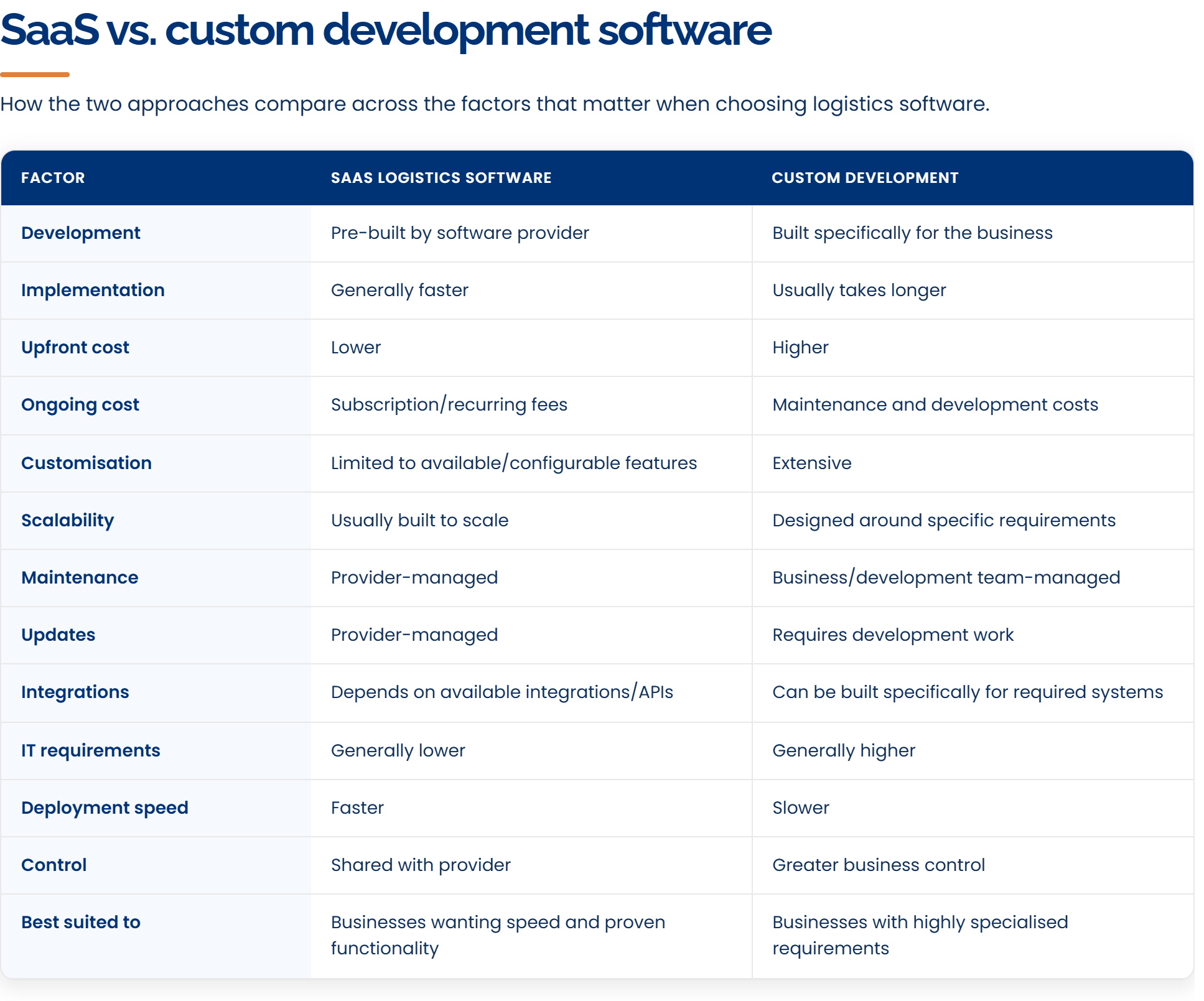
The biggest difference between SaaS and custom logistics software comes down to who designs, maintains, and controls the software. SaaS provides access to an existing platform managed by a software development company, while custom development creates a solution specifically around your business requirements.
Cost
SaaS generally requires a lower upfront investment because businesses pay a recurring subscription instead of funding software development from scratch. However, these subscription fees continue over time. Custom development requires a larger initial investment, along with ongoing costs for maintenance, updates, infrastructure, integrations, and technical support. Businesses should consider the total cost of ownership, including any hidden costs, rather than comparing only the initial price.
Implementation Time
SaaS platforms can typically be configured and deployed much faster because the core software product already exists. Custom development requires requirements gathering, design, development, testing, deployment, and ongoing refinement. This makes custom software a longer-term project.
Flexibility and Customization
SaaS provides configuration within an existing framework. This works well when a business's processes align with the platform's capabilities. Custom software offers greater flexibility because features and workflows can be built around highly specific operational requirements.
Maintenance and Updates
With SaaS, the provider handles much of the technical maintenance, data security, infrastructure, and software updates. With custom software, these responsibilities fall to the business or its custom software development company, requiring ongoing technical resources and continuous improvement.
Integration
SaaS platforms may offer pre-built software with ready-made integrations and APIs for common business systems. However, integration options depend on what the SaaS provider supports. Custom software can be developed around a company's existing ERP systems, WMS, accounting, GPS, CRM, or proprietary systems for truly seamless integration.
Scalability
Both approaches can support business growth, but they scale differently. SaaS is generally easier to scale operationally by adding users, locations, or features supported by the platform. Custom development provides greater control over how the system evolves, allowing businesses to develop new functionality around changing requirements.
When to Choose SaaS Logistics Software
SaaS logistics software can be a practical choice for businesses that want to modernize their operations without taking on the cost, time, and complexity of building a platform from scratch. It is particularly useful when your business needs proven logistics functionality rather than a unique system.
Choose SaaS if:
You need software quickly: A ready-made platform can usually be implemented faster than custom development.
Your processes follow established workflows: SaaS works well when your operations align with common logistics processes.
You want predictable costs: Subscription-based pricing can make software expenses easier to plan and support better decision-making.
You have limited IT resources: The saas provider handles much of the technical maintenance and support.
You want regular updates: Providers typically manage software improvements, security patches, and updates.
Your teams need cloud access: Staff can access the platform from different locations and devices.
You need existing integrations: Many platforms connect with common ERP systems, WMS, accounting, GPS, CRM, and eCommerce systems.
You're growing: SaaS can provide scalable functionality without a major development project.
You want to test digitalisation: You can adopt established technology without committing to building your own platform.
When to Choose Custom Development Logistics Software
Custom development becomes more attractive when standard logistics platforms cannot accommodate the way your business operates. It can provide the flexibility needed for highly specialised workflows, unique operational requirements, and complex technology environments.
Choose custom development if:
Your workflows are highly specialised: Your operations require processes that standard platforms cannot easily support.
SaaS platforms lack critical functionality: Essential processes or features are unavailable through existing solutions.
You need extensive customisation: Your software needs to be built around specific workflows, user roles, or business rules.
You have proprietary or legacy systems: Custom development can support deeper integrations with legacy systems or specialised platforms.
Your processes create a competitive edge: Unique operations can be built directly into the software.
You need greater control: You want full control over features, customer data, workflows, and how the system evolves.
You have sufficient resources: Your business has the budget and technical expertise required to build custom software.
You're prepared for ongoing responsibility: You can manage long-term maintenance, updates, data security, and technical support.
SaaS or Custom Software Development: Which Should You Choose?
The right choice between SaaS solutions and custom logistics software depends on what your business needs most.
For many modern logistics businesses, managing operations involves far more than basic shipment tracking. Teams may need to coordinate transport operations, dispatching, delivery runs, drivers, consignments, customer relationships, electronic proof of delivery, billing, reporting, and integrations across multiple systems, all of which depend on having the right tools in place to boost productivity and support enhancing productivity across the whole team.
This is where a ready-made SaaS platform can be a practical alternative to building software internally. Transvirtual's cloud-based transport management software provides established tools for managing key logistics operations and customer interactions without requiring businesses to develop and maintain their own platform.