US
US
Managing 500+ shipments daily is complex, making the right TMS essential for improving visibility, efficiency, and delivery performance. The biggest factor in achieving fast time-to-value and lower costs is how well the system integrates with your existing ERP ecosystem.
The short answer: If your business needs to get live fast without months of ERP integration work, Transvirtual is the strongest fit. Built for how mid-market transport and logistics operations actually run, it delivers route optimization, carrier management, and compliance without enterprise-level implementation overhead-making it the practical choice for growing operations.
What Defines Large Scale Transportation Operations
Large scale freight management is not simply "managing shipments" at scale. It is a convergence of volume, complexity, and geographic spread that mid-market TMS platforms cannot accommodate without breaking.
Quantitative Thresholds
Common benchmarks are 500+ daily shipments, $50M+ in annual freight spend, and multiple transportation modes. The transportation management system must integrate with existing enterprise resource planning and warehouse management systems.
Complexity Factors
Global or nationwide operations bring customs or cross-border documentation, trade compliance, and currency and tariff variability across domestic and international freight. Carrier management involves hundreds of logistics service providers, freight forwarders, and trucking companies, each with different SLAs.
Why Mid Market Solutions Fail
TMS systems built for mid market shippers can't scale carrier rate management to millions of entries and offer limited global trade compliance. They handle regional load planning fine but stumble on international freight and freight audit workflows at enterprise scale.
Key Benefits of Enterprise Platforms
The right tms platforms cut transportation costs by giving logistics teams real time tracking and supply chain visibility in one place. Enterprise ERP systems paired with sap transportation management or oracle transportation management give large operations the data to optimize routes and hit timely delivery at scale.
TMS for Large Scale Operations: Comparison Guide
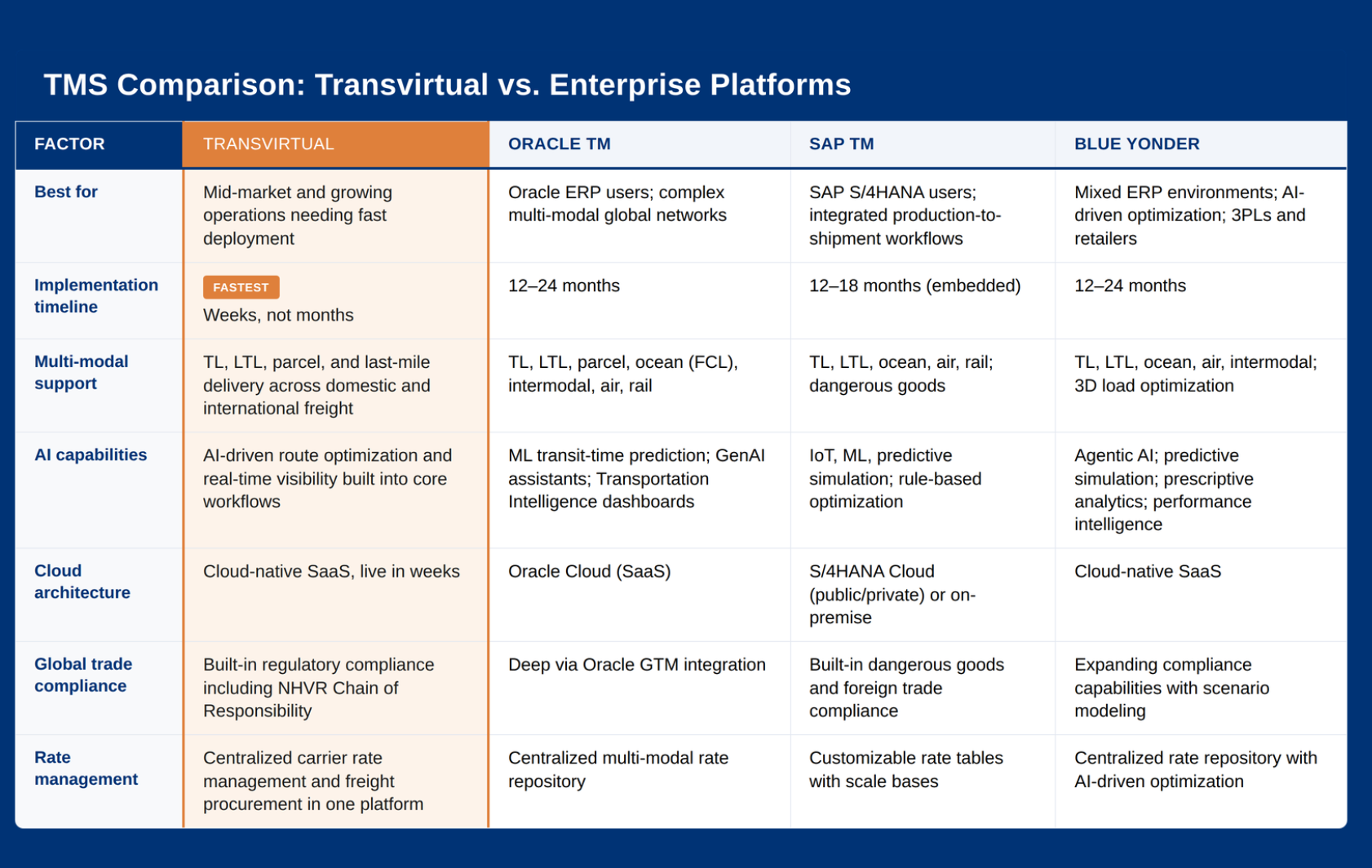
The headline takeaway: ERP alignment drives the decision for global enterprises running Oracle, SAP, or heterogeneous stacks. For operations that don't need a 12-24 month ERP-locked implementation, Transvirtual delivers comparable transport and freight management, carrier management, and real time tracking without the enterprise overhead.
Comparing TMS Software in Terms of Features and Offers
ERP Integration and System Architecture
Integration determines whether a transportation management system becomes a true single source of truth or another disconnected tool.
Oracle TM and SAP TM integrate deeply with their respective enterprise resource planning systems, but only if you're already running that ERP.
Blue Yonder works across mixed ERP systems but needs heavy upfront investment in data harmonization to get there.
Transvirtual connects to the systems mid market shippers actually use, without demanding a lengthy ERP alignment project first. It's a flexible tms that unifies order management, warehouse management system data, and carrier systems on one platform, so logistics teams get supply chain visibility fast.
Scalability and Performance
Oracle TM has the strongest track record at extreme enterprise scale, and SAP TM and Blue Yonder both scale well but demand significant infrastructure investment to get there.
Transvirtual is a cloud-native, modern tms built to scale with growing shipment operations rather than for organizations already managing tens of thousands of daily shipments. That means faster tracking freight, real time tracking, and shipment visibility without heavy enterprise systems overhead.
Advanced Analytics and AI Capabilities
Blue Yonder leads on agentic AI, Oracle TM offers strong transit-time prediction, and SAP TM's analytics are solid but less TMS-specialized. All three require significant configuration to unlock these tools.
Transvirtual builds AI-driven route optimization and real time visibility directly into everyday transportation planning and shipment scheduling, giving logistics teams shipment status and transport data without a dedicated AI rollout.
Implementation Complexity and Total Cost of Ownership
Enterprise platforms typically take 12 to 24 months to deploy, with costs stretching well past licensing into freight audit, freight billing, and freight bill auditing setup, training, and change management.
Transvirtual gets operational in weeks, reducing costs and manual data entry from day one, with a total cost of ownership built for mid market shippers rather than enterprise implementation timelines.
Which TMS Should Your Large Scale Operation Choose?
Choose Transvirtual if you want a modern TMS that lowers transportation costs and shipping costs, keeps carrier management and shipment tracking on one platform, and gets your logistics teams live fast without enterprise-scale complexity.
Decision framework considerations:
Annual freight spend: as spend scales into tens of millions, tighter optimization justifies higher implementation investment, but evaluate total cost of ownership, not just license fees, since integration and training costs add up fast.
ERP platform alignment: the most influential lever. Simplifying TMS deployment requires considering existing technology and integration needs, and native integration consistently outperforms bolted-on connectivity.
Strategic priorities: plan for long-term partnership, not just a one-time purchase.
Speed vs. customization: modern TMS solutions should be cloud-first to handle large transaction volumes, and cloud-native architectures are becoming standard for TMS solutions to enhance flexibility. Compatibility with various transport modes impacts TMS effectiveness, so weigh deployment speed against how much customization your operation actually needs.
Before committing to any platform, define requirements before engaging with TMS vendors and check references from companies of similar size and industry.